
Skip to content
Independent gardening guides. Some links earn us a commission at no cost to you. Read our affiliate disclosure
Newsletter
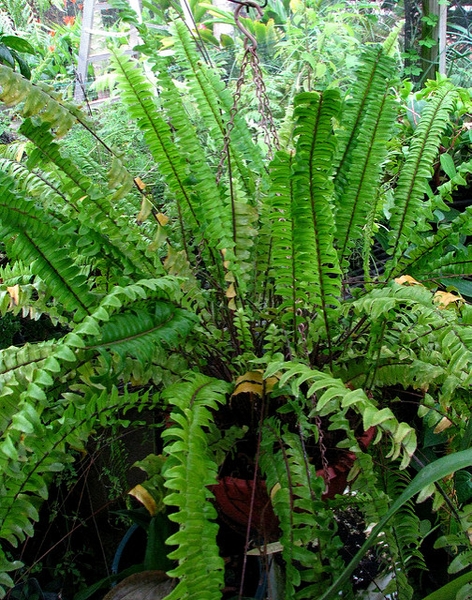
Boston fern (Nephrolepis exaltata)

Photo: David Eickhoff, CC BY 2.0, via NC State Extension Plant Toolbox (https://plants.ces.ncsu.edu/plants/nephrolepis-exaltata/). Original: https://eit-planttoolbox-prod.s3.amazonaws.com/media/images/Nephrolepis_exaltata_David_Eickhoff_ccby2.0.jpg. Licence: https://creativecommons.org/licenses/by/2.0/. Rehosted for SwipeGarden without intentional crop.

Boston fern

Nephrolepis exaltata · Polypodiaceae

Also known as: Boston fern, sword fern, Nephrolepis exaltata 'Bostoniensis' (cultivated Boston fern form)

Boston fern has arching, divided fronds and needs bright filtered light, consistently moist but well-drained potting mix, and humid air. ASPCA lists Boston fern as non-toxic to cats and dogs.

Light
Medium light, Bright indirect light
Care level
Some experience helpful
Where it grows
Indoors, Outdoors in warm climates
Cats and dogs
Non-toxic to pets Source (opens in a new tab)

ASPCA's Boston Fern entry (spelled 'Nephrolepis exalta bostoniensis' there) lists non-toxicity for cats and dogs. The NC State profile identifies Boston fern within Nephrolepis exaltata. This is not a safety claim about other fern-like houseplants; confirm species identity. Non-toxic does not mean recommended as food. Contact a veterinarian if a pet develops symptoms after chewing any plant.

View My Garden

Check a problem with this plant

How to identify it

Boston fern is an arching, fountain-shaped fern with long fronds divided into many small leaflets (pinnae). The species is Nephrolepis exaltata; the commonly sold Boston form is often called 'Bostoniensis'. NC State Extension's species profile describes the tapering, finely divided fronds and the small round spore clusters on the underside. Those orderly brown dots can be normal spores, not insect eggs or disease.

Look for firm green fronds emerging from the plant's central crown, not woody stems or flowers. The plant works well in a hanging basket with room for its fronds to arch. If you are buying a cultivar with a different frond shape, verify its label rather than assuming every fern sold at a nursery is this species.

Light

Give bright, filtered light rather than hot direct afternoon sun. NC State Extension recommends bright indirect indoor light and lists dappled shade outdoors. A bright room set back from harsh glass or a lightly shaded east-facing window is a useful starting point. Watch the actual plant: drying, bleached leaflets can reflect too much heat or direct sun as well as dry air.

In a dim corner, growth may become thin. Reposition gradually rather than sharply increasing light in a single day. For measuring conditions beyond the window direction, use the houseplant light guide.

Potting mix and drainage

Use a moisture-holding but well-drained container mix in a pot with working drainage holes. Boston fern is not a drought-adapted plant, yet water standing around its roots can cause damage. A standard peat-free or organic houseplant potting mix that stays evenly damp without remaining soggy is a reasonable starting point; its exact recipe can vary with indoor humidity and pot size.

Iowa State Extension explains why containers need drainage holes and why gravel at the bottom does not solve poor drainage. Empty the catch tray after watering, and avoid a decorative cachepot that traps standing water.

When to water

Check the mix and water before the root zone dries out completely. NC State Extension says Boston fern needs moist soil and should not be allowed to dry out; it also warns that excess winter watering can cause root rot. Touch the mix just below the surface, check the pot's weight, and water when it begins to lose moisture rather than following a weekly schedule. Water through the pot until excess drains, then empty the saucer.

Light, indoor heating, pot size and humidity change the interval. Keep moisture more steady during active warm-season growth, and reassess in cooler, darker periods rather than applying a fixed dose. If the mix is wet and fronds wilt, inspect drainage and roots instead of automatically adding water. See how to check potting-mix moisture.

Humidity and temperature

Boston fern prefers humid air and warmth. NC State Extension recommends humid conditions and indoor warmth around 60–70°F (16–21°C). It suggests a humid room such as a bathroom or kitchen, or a pebble tray with water kept below the pot. Keep the plant clear of forced-air heating and cold drafts.

Dry indoor air often shows up as brittle brown leaflet tips, but browned fronds are not proof of one cause: check both pot moisture and nearby heat. Outdoors, the NC State hardiness guidance lists zones 10a–13b; bring plants indoors before cold weather outside a reliably frost-free climate. USDA zones describe average minimum winter temperatures, not this week's frost forecast.

Feeding

Boston fern does not benefit from fertilizer poured onto dry or struggling roots. During visible active growth, use a balanced houseplant fertilizer at its labelled rate and avoid building up salts in the potting mix. Iowa State Extension's houseplant guidance recommends limiting feed during slow winter growth and being careful with established potting mixes that already contain fertilizer.

If growth stalls, first assess light, water, roots and temperature rather than assuming a nutrient deficiency.

Propagation

Boston fern produces spores and can spread by short rhizomes and slender runners. NC State Extension documents both the spore-bearing fronds and the plant's runner-like growth. If an established plant has a separate rooted crown or runner, it may be possible to pot that rooted portion independently; keep roots intact and the fresh potting medium evenly moist. Do not assume a detached frond will grow into a complete fern.

Raising ferns from spores is different from taking a flowering plant's seed. On a mature frond, spores can look like neat rows of brown specks underneath; identify them before assuming a pest problem. For gardeners without propagation experience, maintaining a healthy existing plant is a better first project than growing spores.

Growth and size

In good conditions, Boston fern forms a dense, cascading clump. NC State Extension gives a typical plant size of about 2–3 feet tall and wide and describes a leafy, arching habit suited to baskets, containers and sheltered shade. Different cultivated forms vary in leaflet shape and density.

It has no flowers or fruit: like other ferns it reproduces through spores, which develop on the frond underside. In warm climates the species can spread; check local guidance before planting it directly outdoors, because NC State notes invasive tendencies in suitable regions.

Warning signs

  • Crisp brown tips or fronds: check humidity, direct hot sun, missed watering and nearby heaters; do not assume one cause without observing the conditions (NC State).
  • Wilting while the pot is wet: check for standing water, poor drainage and affected roots; adding more water may worsen the problem (Iowa State).
  • Fine webbing or fixed bumps on fronds: NC State lists spider mites and scale as potential pests, particularly in dry air. Inspect frond undersides and identify the problem before choosing treatment; no pesticide doses are advised.
  • Neat dark dots under healthy leaflets: these may be natural spores, not pests. Compare their regular pattern with NC State's photographs.

Related guides

Sources

  1. NC State Extension Gardener Plant Toolbox: Nephrolepis exaltata — species identity, culture, hardiness, reproduction and pests (checked October 13, 2026)
  2. ASPCA Animal Poison Control: Toxic and Non-toxic Plants: Boston Fern (checked October 13, 2026)
  3. Iowa State University Extension: How to Care for Houseplants (checked October 13, 2026)

Last reviewed