
Chlorophytum comosum is a clump-forming houseplant with slender, arching, strap-like leaves. Many sold forms carry lengthwise cream or white stripes, although leaf markings vary by cultivar. Mature plants can send out long flowering runners that hold small white flowers and miniature rooted-looking plantlets. Those hanging offsets, rather than spider mites, explain its common name. NC State Extension's plant profile describes the arching form and names several variegated and curly-leaved cultivars.
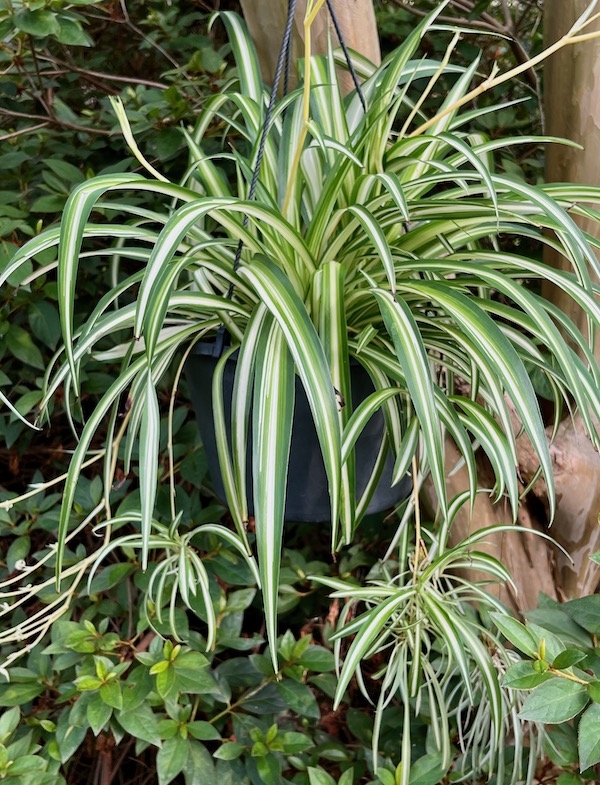
Photo: Joanne Kollar (Pitt County), CC BY 4.0, via NC State Extension Plant Toolbox (https://plants.ces.ncsu.edu/plants/chlorophytum-comosum/). License: https://creativecommons.org/licenses/by/4.0/. Rehosted without intentional crop.
Spider plant
Chlorophytum comosum · Asparagaceae
Also known as: Ribbon plant, spider ivy, spiderplant, walking anthericum
Spider plant has arching green or striped leaves and dangling plantlets. Give it filtered light, a draining pot, and water according to soil moisture.
- Light
- Low light tolerant, Medium light, Bright indirect light
- Care level
- Beginner friendly
- Where it grows
- Indoors, Outdoors in warm climates
- Cats and dogs
- Non-toxic to pets Source (opens in a new tab)
ASPCA lists Chlorophytum comosum as non-toxic to both cats and dogs. This is a toxicology classification, not a recommendation to let pets graze on houseplants. If an animal appears ill after eating a plant, seek veterinary advice.
How to identify it
Light
Place spider plant in medium to bright, indirect light. NC State Extension lists medium light as preferred and notes the plant can tolerate deep shade, but it does not like strong direct sunlight. Tolerating a shady spot does not mean it will grow as quickly or produce as many offsets there. If leaf color fades or growth slows, assess the actual light at the plant before changing fertilizer or watering.
Iowa State Extension explains that bright indirect light is bright enough to cast a distinct shadow without direct sun striking the foliage. Curtains and distance from the window matter more than window direction alone.
Potting mix and drainage
Use ordinary indoor potting mix in a container with a clear drainage hole; the mix should hold a little moisture but drain freely. NC State Extension lists well-drained, moist soil. Iowa State Extension warns that gravel placed at the bottom of a hole-free pot does not correct its drainage problem.
Hanging baskets suit the arching leaves and runners, but a normal pot works just as well. When roots crowd the container, move to only a slightly larger pot; an oversized wet mass takes longer to dry.
When to water
Check the mix rather than following a weekly schedule. Push a finger about an inch into the soil. If it feels dry, water thoroughly until excess runs from the drainage hole, then empty the saucer. If it is still damp, wait and check again. This touch test follows Iowa State Extension's general houseplant method and suits a spider plant's preference for moist but well-drained soil described by NC State Extension.
In cooler or dimmer winter conditions, check just as often but expect to water less. Spider plants tolerate occasional drying, yet repeatedly saturated roots are not the same as evenly moist soil.
Humidity and temperature
Spider plant generally manages average home humidity, with some benefit from moderately humid air. NC State Extension describes a preference for medium humidity and advises keeping temperatures above 45°F (about 7°C). That number is a lower caution, not an ideal target: use an ordinary, comfortably warm indoor room rather than exposing it to cold drafts.
If the room is extremely dry, a humidifier is more predictable than regular leaf misting. Keep any pebble-tray water below the pot, so roots do not sit in it.
Feeding
Feed lightly, if needed, only while the plant is actively producing new leaves. Follow the fertilizer's label rather than increasing the dose to force more plantlets. NC State Extension specifically notes that over-fertilizing can reduce plantlet formation; Iowa State Extension recommends cutting back on houseplant feeding during slow winter growth.
Propagation
The simplest way to make another spider plant is to use a plantlet on a long runner. Set a plantlet with developing root nubs onto a small pot of damp, draining mix and let roots establish before cutting it from the parent. A mature crowded clump can also be divided, keeping roots with each section. NC State Extension identifies both plantlets and division as practical propagation methods.
Not producing plantlets yet? First give the parent stable light and time. Different cultivars and growing conditions produce offsets at different rates.
Growth and size
Spider plant forms a soft, cascading clump. NC State Extension describes mature foliage about 12–18 inches (30–45 cm) tall and a 12–24 inch (30–60 cm) spread; long runners extend beyond those dimensions. Leaf striping and curling depend on cultivar. Its compact footprint makes it suitable for shelves and hanging planters, provided the pot can drain.
Warning signs
- Brown leaf tips: can be associated with water quality, fertilizer salts or dry conditions. NC State Extension mentions sensitivity to chlorine and fluoride in some tap water; also check fertilizer use and overall moisture rather than assuming one cause.
- Persistently soggy soil or collapsing growth: check for poor drainage and unhealthy roots before adding water.
- Sudden pale or scorched-looking patches: see whether direct sun reaches the leaves; this is not a plant for all-day harsh sun.
- No small plantlets: offset production depends on conditions and maturity; NC State Extension says overfeeding can reduce it. Do not increase feeding to force offsets.
Related guides
Sources
- NC State Extension Gardener Plant Toolbox: Chlorophytum comosum: species, culture, propagation and USDA zones (checked October 12, 2026)
- ASPCA Animal Poison Control: Toxic and Non-toxic Plants: Spider Plant (checked October 12, 2026)
- Iowa State University Extension and Outreach: How to Care for Houseplants (checked October 12, 2026)
Last reviewed