
Independent gardening guides. Some links earn us a commission at no cost to you. Read our affiliate disclosure
Newsletter
Weeping fig (Ficus benjamina)

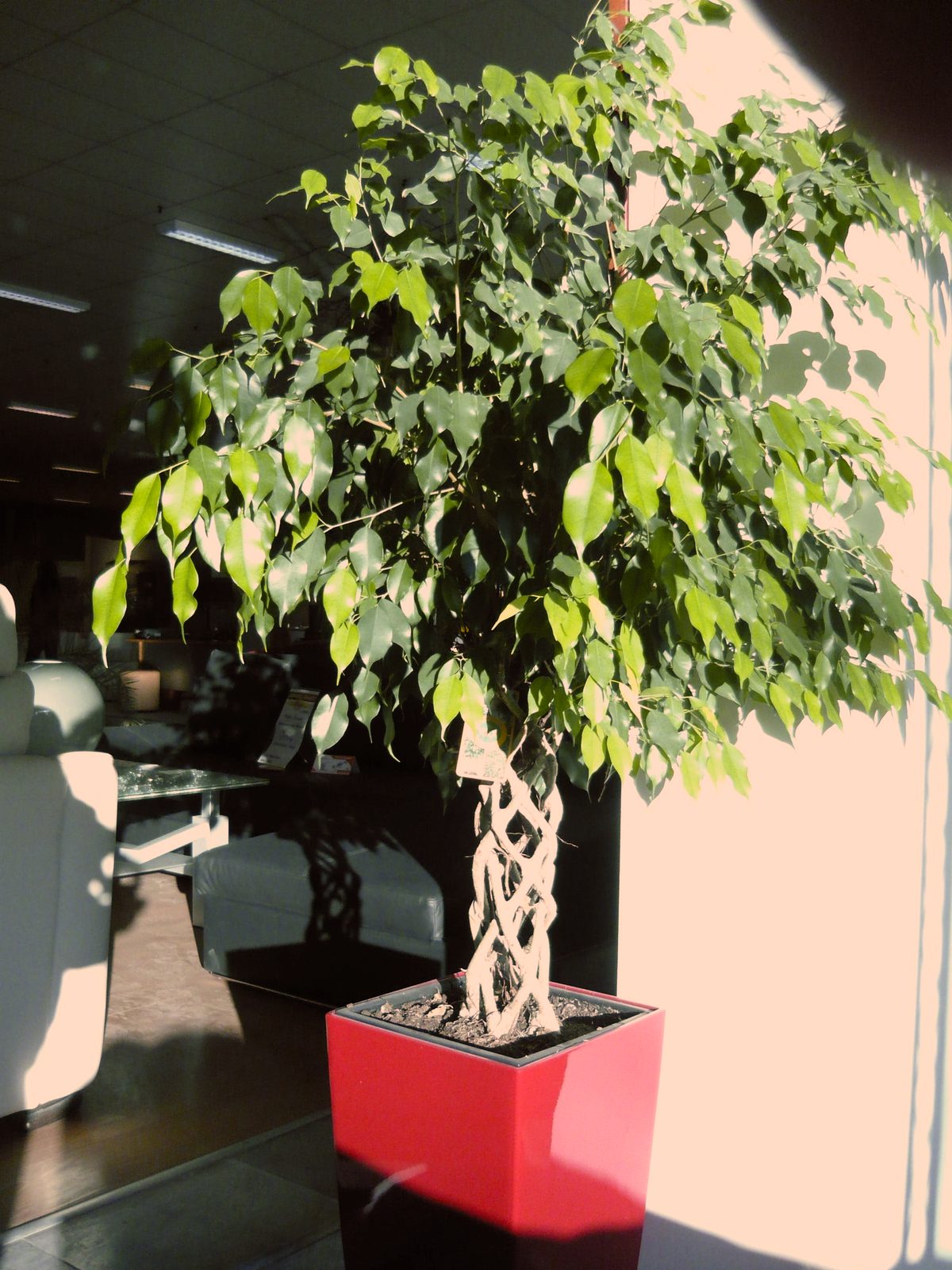
Photo: Darsie, Public domain via Wikimedia Commons

Weeping fig

Ficus benjamina · Moraceae

Also known as: Ficus, Ficus tree, Ficus benjamina, Benjamin fig, Benjamin tree, Java fig, Small-leaved rubber plant, Weeping ficus, Fig, Danielle, Too Little, Variegata, Golden King, Wintergreen, Exotica

A small-leaved fig with arching branches. It likes bright indirect light and evenly moist mix, and sheds leaves when moved, chilled or stressed.

Light
Medium light, Bright indirect light
Care level
Moderate
Where it grows
Indoors, Outdoors in warm climates
Cats and dogs
Toxic to pets Source (opens in a new tab)

The ASPCA lists Ficus benjamina (on its "Fig" page, also called weeping fig) as toxic to dogs and cats, with gastrointestinal and dermal (skin) irritation as clinical signs. If a pet chews this plant, contact your vet or an animal poison control service.

View My Garden

Check a problem with this plant

How to identify it

Weeping fig (Ficus benjamina, family Moraceae) has slender, drooping branches and small, glossy leaves about 2 to 5 inches long. NC State Extension describes the leaves as oval with a long, pointed tip, folding in toward the midrib and hanging downward. The flexible stems are sometimes intertwined to form a decorative trunk.

NC State lists many cultivars, including 'Danielle', 'Too Little', 'Variegata', 'Golden King' and 'Wintergreen', with plain green or cream-edged leaves. Common names overlap with other figs: NC State and the ASPCA also use "Indian rubber plant" and plain "fig" for this species, so check the scientific name on the label.

Light

Clemson Extension says weeping figs grow best in bright indirect or curtain-filtered sunlight, and will handle some direct sun if the humidity is high. Variegated cultivars grow best in somewhat lower light. NC State adds that it performs best in bright, indirect light but will survive in shade.

Light also explains much of the leaf drop after a move. NC State says the plant is very sensitive to light, so after a change of position it may drop leaves and grow new ones suited to the new conditions. Clemson lists low light among the causes of leaf drop, too. Pick a bright spot and leave the plant there; the RHS notes that weeping figs dislike being moved.

Potting mix and drainage

NC State says weeping fig grows well in a soil-based potting mix, and Clemson recommends a general-purpose potting soil. Use a pot with drainage holes: Clemson notes that root rot usually comes from a mix that drains poorly or from watering too often, and that plants should never sit in water in their saucers.

Weeping figs tolerate being slightly root-bound, and Illinois Extension says they prefer crowded roots in a small pot. Clemson suggests repotting in late winter or early spring once the plant is overcrowded, which shows as slow growth and small new leaves. Expect some leaf drop after repotting while the plant settles.

When to water

Weeping fig likes steadier moisture than many houseplants. Clemson advises keeping the soil evenly moist during active growth and letting it dry slightly between waterings in winter and other slow periods. NC State says to water just often enough to keep the soil from drying out completely.

Check the mix with a finger before watering. If the surface is starting to dry, water and let the excess drain away; if it is still wet, wait. Never leave the pot standing in water. Penn State Extension links leaf drop on weeping fig to low soil moisture and low humidity, and Clemson lists both overwatering and underwatering among its causes.

Humidity and temperature

Clemson says weeping figs prefer high humidity, while Illinois Extension says they grow well at medium humidity, so avoid very dry spots. Clemson gives ideal temperatures of 65 to 70°F at night and 75 to 85°F during the day.

Cold and drafts are the bigger problem. Illinois Extension notes that the leaves drop if the plant is chilled, and NC State describes it as intolerant of cold and very frost sensitive. Clemson warns that a plant placed near a heat vent or in a draft will shed leaves. For indoor figs, the RHS recommends a warm, even temperature without large swings, away from draughts.

Feeding

Feed only during the growing season and follow the product label rate. Clemson suggests a liquid fertilizer for healthy plants during the growing season, and NC State notes the plant may benefit from light fertilization after new shoots form and at the end of summer. Iowa State Extension advises fertilizing houseplants only while they are actively growing.

Both too little and too much can cause trouble. Clemson lists lack of nitrogen among the causes of leaf drop, while the RHS lists too much fertilizer. If leaves are falling, check light, drafts and watering first, since Clemson and the RHS list those causes too.

Propagation

Weeping fig roots from stem cuttings, and it can also be air layered. Clemson says cuttings are best taken in summer, while air layering can be done in any season. For indoor figs, the RHS suggests semi-ripe cuttings in spring or summer, with a heated propagator to help them root.

Iowa State Extension lists weeping fig among plants suited to air layering: a ring of bark is removed from the stem, the wound is wrapped in moist sphagnum moss and clear plastic, and the rooted top is cut off and potted once its roots are several inches long. The RHS warns that fig sap may irritate skin, so wear gloves.

Growth and size

Weeping fig is a tree native to southeastern Asia and Australia that can reach 40 to 50 feet outdoors. As a houseplant it is usually kept at 2 to 10 feet tall, according to NC State, and dwarf forms suit indoor spaces better; miniature cultivars such as 'Too Little' are popular for bonsai.

It takes pruning well. Clemson says it can be pruned to shape as needed and tolerates hard pruning to reduce its size, and that heavily pruned plants need less water afterwards. NC State notes that the stems may be intertwined for decorative effect, which is why many indoor plants have braided trunks.

Warning signs

  • Sudden leaf drop: the most common weeping fig problem. Check what changed: a move, repotting, a draft, a heat vent, cold, low light, or mix that is too wet or too dry. Correct the cause, then leave the plant in place; Clemson notes it usually recovers and puts out new growth once conditions suit it.
  • Leaves yellowing and falling: feel the mix. Penn State links this to low soil moisture and low humidity, and the RHS links yellowing to overwatering. Water to keep the mix evenly moist, not wet.
  • Angular yellow spots that turn brown: Penn State lists bacterial leaf spot as one possible cause. Avoid wetting the leaves when you water, and ask your local extension office if spots keep spreading.
  • Pests on stems or leaves: Clemson names spider mites and scale as frequent weeping fig pests, and mealybugs, aphids and thrips can also infest it. Check stems and leaf undersides, identify the pest, then use a product labelled for it and follow the label.

Sources

  1. ASPCA Animal Poison Control: Fig (Scientific Name: Ficus benjamina) (checked October 11, 2026)
  2. ASPCA Animal Poison Control: Weeping Fig (Scientific Name: Ficus sp.) (checked October 11, 2026)
  3. ASPCA Animal Poison Control: Indian Rubber Plant (Scientific Name: Ficus benjamina) (checked October 11, 2026)
  4. NC State Extension Gardener Plant Toolbox: Ficus benjamina (Benjamin Tree, Chinese Banyan, Fig, Indian Rubber Plant, Java Fig, Small-leaved Rubber Plant, Weeping Fig) (checked October 11, 2026)
  5. Clemson Cooperative Extension, Home & Garden Information Center: Weeping Ficus (HGIC 1514) (checked October 11, 2026)
  6. University of Illinois Extension: Weeping Fig (Houseplants) (checked October 11, 2026)
  7. Royal Horticultural Society (RHS): How to grow ornamental figs (checked October 11, 2026)
  8. Penn State Extension: Ficus Diseases (Gary W. Moorman) (checked October 11, 2026)
  9. Iowa State University Extension and Outreach: How to Propagate Houseplants by Air Layering and Simple Layering (checked October 11, 2026)
  10. Iowa State University Extension and Outreach: How to care for houseplants (checked October 11, 2026)
  11. Clemson Cooperative Extension, Home & Garden Information Center: Indoor Plants: Cleaning, Fertilizing, Containers & Light Requirements (checked October 11, 2026)

Last reviewed