
Quick answer: For a few houseplants or garden beds, begin with your finger, the weight of the pot and a simple soil probe rather than treating an inexpensive meter as a precise irrigation controller. For regular monitoring or automated irrigation, select a sensor that measures either soil water content or soil water tension, can operate at the intended depth and can be interpreted for your soil type. No sensor reading is meaningful without checking plant needs and the surrounding soil.
What do soil moisture sensors measure?
Two useful measurements are volumetric water content (how much of the soil volume is water) and water tension (how strongly water is held by the soil). Different sensors estimate these by using electrical properties, a ceramic cup or a porous block. Inexpensive “dry–wet” scales often give relative readings, not laboratory percentages. Read the device's specifications before relying on a number.
Compare the main sensor types
| Type | Best use | Trade-off |
|---|---|---|
| Simple handheld probe / resistance meter | Quick spot checks at multiple pots or beds | Often relative rather than calibrated; salts and soil contact may affect results |
| Capacitance / dielectric sensor | Regular readings, irrigation monitoring, some smart systems | Soil-specific calibration may be necessary; salinity and texture influence the output |
| Tensiometer | Monitoring water availability in a managed root zone | Needs maintenance and has limited usefulness in very dry soil |
| Granular-matrix sensor | Continuous soil tension monitoring at chosen depths | Response and calibration depend on soil conditions |
| Time-domain reflectometry (TDR) | Higher-end water-content measurements | More expensive and a small area is measured |
University of Minnesota Extension describes these technologies and their limitations in its soil moisture sensor reference. It is primarily about agricultural irrigation; home gardeners should apply the sensor principles, not copy field-specific thresholds.
Choose by the garden, not by the plant name alone
Houseplants and containers
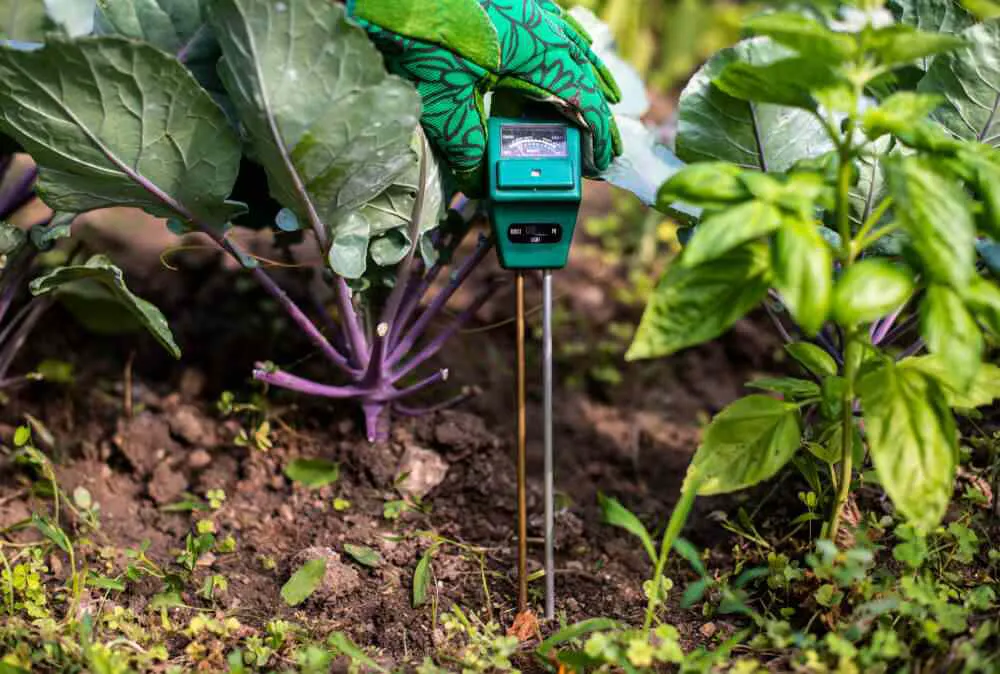
A portable probe can help compare moisture through the potting mix. Push it into the root zone without damaging major roots, and verify with the pot's weight or a wooden skewer. A small reading near the rim may not represent moisture at the center of a large pot.
Raised beds and vegetables
Use readings where active roots are growing, and move the probe among representative positions. A sensor at the surface can dry long before deeper roots do. Do not irrigate solely because a superficial reading is low.
Large gardens or irrigation systems
Choose a system with a documented measurement range, suitable environmental protection, repeatable readings, adequate cable/connection length and accessible history. Multiple depths or locations may be needed when beds have different soil textures or water delivery patterns.
How to judge accuracy and reliability
- Identify the output: percentage water content, tension, or a relative dial index.
- Check calibration: a vendor claiming “accurate” should state the soil conditions and expected error. Dielectric sensors can be affected by salinity, bulk density and temperature.
- Check contact: air gaps around the sensing surface can skew results.
- Test repeatability: compare dry, moderately moist and thoroughly wetted soil from the same pot or bed; allow an appropriate settling period.
- Observe plant responses: leaf wilting, recent irrigation and drainage provide context, but leaf symptoms alone do not diagnose soil moisture.
What should you look for before buying?
- Sensor depth appropriate to your root zone and sturdy construction for your soil
- Stated measurement unit, precision and calibration requirements
- Availability of replacement probes, batteries and waterproofing if left outdoors
- Data logging or automation only if you genuinely need it
- A clear manual explaining how and where to take the reading
Common mistakes
Do not compare a numeric reading from sandy soil directly with a reading from clay soil and assume the plant has equal access to water. Do not force a fragile probe into compacted dry ground. Do not use a moisture meter as a substitute for drainage holes or inspection of damaged roots. A pot may have a wet center but a dry surface.
Frequently asked questions
Which type is best for beginners?
A simple handheld probe can be useful as a second opinion, but learning how your pot or soil behaves when watered is often more important than buying electronics.
Can a meter prevent overwatering?
It can give additional evidence, but overwatering depends on drainage, root condition, watering frequency and the potting medium—not a single threshold.
Should I use the same reading for every plant?
No. Different plants and mixes tolerate different moisture ranges; use plant-specific care guidance and observe root-zone conditions.