
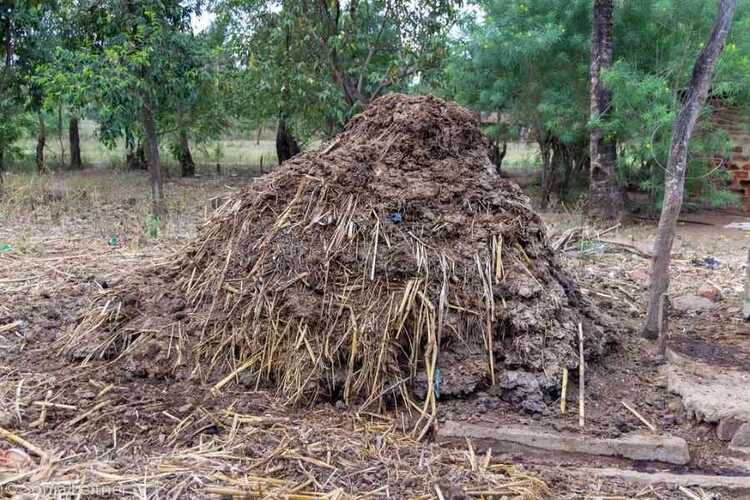
Store finished compost in a sheltered, well-drained place and protect it from soaking rain, runoff and weed seeds. A covered bin, roofed bay or secured tarp can help. Keep the material reasonably crumbly rather than saturated or bone dry, and do not confuse still-hot active compost with stable compost that is ready to store.
Check that the compost is actually finished
Finished compost should be dark, relatively uniform and earthy smelling, without readily recognizable fresh food scraps. Material that still heats strongly when turned, contains raw scraps or smells of ammonia may need more curing. Maturity depends on the materials and process, not a fixed number of days.
Where to keep it
| Storage option | What to watch |
|---|---|
| Roofed storage bay | Keep it off flood-prone surfaces and protected from windborne weed seeds |
| Tarped pile | Secure the tarp, let rain shed away and avoid trapping runoff beneath it |
| Covered ventilated bin | Provide drainage and check for overly damp, compacted material |
| Small lidded container | Use only for properly matured compost; monitor moisture and smell |
How to store compost step by step
- Separate finished compost from raw incoming material to prevent contamination.
- Choose a stable, sheltered spot away from drains, streams and frequent flooding.
- Use a tarp or a roof during wet weather; Oregon State University Extension specifically notes that finished compost may be tarped.
- Check occasionally for saturated clumps, excess dryness, pests or weed growth. Correct the storage conditions rather than spraying chemical treatments.
- Keep notes about batches and use older, stable material first when it is appropriate for the job.
Should the compost be wet or dry?
Avoid extremes. Wet compost can clump, become hard to handle and generate leachate; excessively dry compost can be dusty and resist mixing. Oregon State University Extension reports that finished compost above 60% moisture tends to be clumpy, while below 40% it can become dusty. These are handling indicators, not a home rule requiring laboratory moisture measurements.
Does stored compost lose all its nutrients?
No, but repeated soaking and runoff can move soluble nutrients from the pile and cause water-quality problems. Mature compost still has organic matter value, though fertilizer content varies by feedstock and process. Avoid claims of an exact nutrient-loss percentage without testing the actual batch.
How long can you keep it?
There is no single expiry period. Stored compost may remain useful for months or longer when protected from contamination and excess weathering, but monitor its condition. Material that develops fresh contamination, weed seeds or an offensive odor should be assessed before use. For seedlings, use a properly formulated and clean seed-starting mix instead of assuming stored compost is suitable alone.
How to use it after storage
Screen out large undecomposed fragments if the job needs a fine material. Apply compost at a rate appropriate for the crop and soil test; avoid repeatedly piling thick layers onto beds that already have high phosphorus. For a detailed starting point, see the guide to adding compost to garden soil.