
Aloe vera forms a rosette of thick, pointed, fleshy leaves. The gray-green leaves have small teeth along their edges and store water. It is not a cactus, and not every plant sold as 'aloe' is Aloe vera. NC State Extension lists Aloe barbadensis among earlier botanical names and places the species in Asphodelaceae. Mature plants may produce a tall stalk of tubular yellow-to-orange flowers, but indoor plants do not reliably flower.
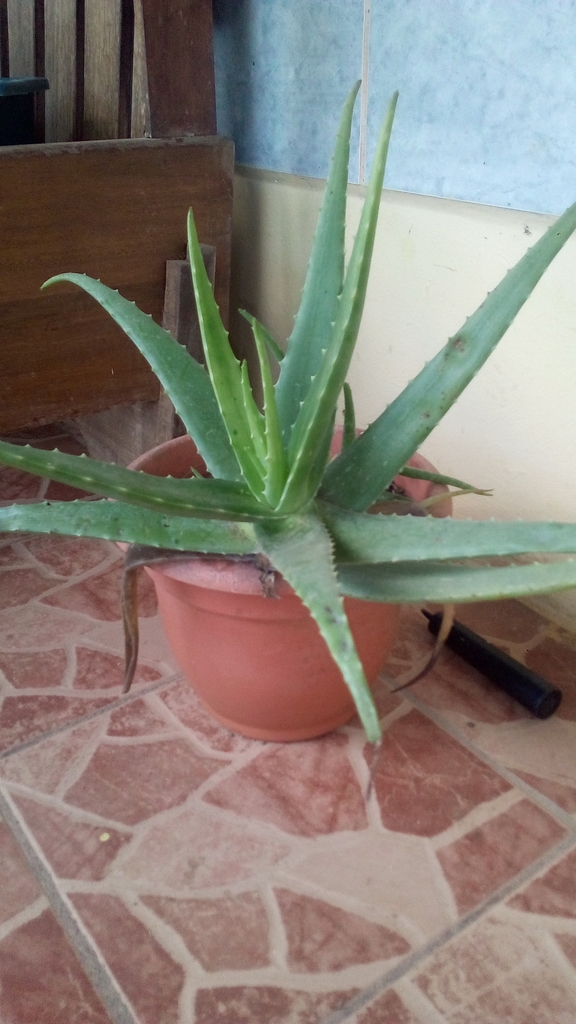
Tim Kortekamp, Aloe vera in a pot, CC BY-SA 4.0 via NC State Extension Plant Toolbox: https://plants.ces.ncsu.edu/plants/aloe-vera/. Original https://eit-planttoolbox-prod.s3.amazonaws.com/media/images/Aloe_vera_Form_in_a__7JIpdVIH2OAj.jpeg. License: https://creativecommons.org/licenses/by-sa/4.0/.
Aloe vera
Aloe vera · Asphodelaceae
Also known as: Aloe; medicinal aloe; Barbados aloe; Aloe barbadensis (older name)
Aloe vera is a rosette-forming succulent with fleshy, toothed leaves. Keep it in bright light and sharply draining soil; let the mix dry completely before watering again. ASPCA lists aloe as toxic to cats and dogs.
- Light
- Bright indirect light, Some direct sun
- Care level
- Beginner friendly
- Where it grows
- Indoors, Outdoors in warm climates
- Cats and dogs
- Toxic to pets Source (opens in a new tab)
ASPCA lists Aloe vera as toxic to dogs and cats. The fact that certain properly prepared aloe products are used by people does not make the houseplant safe for pets. If an animal eats it, contact a veterinarian or an animal poison service rather than trying a home treatment.
How to identify it
Light
Give the brightest suitable window or a partly sunny outdoor position. NC State describes full sun to partial shade in an appropriate growing climate. An indoor aloe may need time to adjust before receiving intense direct sunlight, particularly after living in a shaded store. Watch how the foliage responds instead of assuming a fixed window direction suits every home. Learn how to judge light indoors.
Potting mix and drainage
Use a loose, very well-drained mix designed for succulents and a pot with drainage holes. NC State emphasizes sharp drainage and notes clay containers as one workable option. Do not let excess water remain in an outer planter or saucer. A dense, wet mix can hold moisture longer than aloe roots tolerate; adding gravel below a pot without drainage is not a replacement for proper holes. See Iowa State's general houseplant-care guidance.
When to water
Let the potting mix dry completely between waterings. That is the condition given by NC State Extension. Check below the top layer with a wooden probe or similar moisture check; the surface alone may look dry while lower parts remain wet. Once dry, water the potting mix and let the extra water leave through the holes. NC State recommends watering less often during winter. Never assume a weekly schedule: temperature, light, plant size, pot material and mix change the drying time. Read the pot-moisture guide.
Humidity and temperature
Aloe is a warm-climate succulent. NC State lists outdoor hardiness zones 10a–12b; bring container plants inside before freezing temperatures threaten, even if a climate map suggests a mild region. Avoid cold, wet conditions and keep the pot away from frosty glass. The referenced sources do not establish a reliable target indoor humidity percentage for this species, so no exact humidity number is recommended.
Feeding
Feed lightly, if at all, while growth is active and conditions are suitable. Follow a container-plant fertilizer's printed instructions instead of inventing a special dose for aloe. Fertilizer does not correct waterlogged roots, low light or a cold location. The Iowa State houseplant guide explains general limits of indoor feeding; this profile does not claim a research-backed aloe-specific interval.
Propagation
Propagate aloe by separating rooted offsets ('pups') when they develop beside the parent. NC State describes offset growth and division, rather than depending on single-leaf cuttings. Wait until a pup has a viable root system, lift it gently, and pot it into an appropriately draining medium. Avoid leaving fresh divisions in standing water. Growth is variable, so observe new roots and leaves instead of promising a number of days.
Growth and size
Aloe's upright succulent leaves emerge from a basal rosette. NC State notes that mature plants can grow to roughly two or three feet tall and form offsets, though indoor growth depends on light and container conditions. It is a fleshy perennial, not an evergreen vine. A compact plant may stay small for years without being unhealthy, particularly in a pot.
Warning signs
- Soft, translucent or collapsing tissue with wet mix: check drainage and roots; excess moisture may be involved. Avoid asserting a disease from appearance alone.
- Leaves thinning or folding: check how dry the full mix is and examine roots before adding water.
- Brown or pale exposed patches: consider recent changes in light and heat; a single patch is not a diagnosis.
- Spots, sticky residue or insects: inspect both leaf surfaces and leaf bases, identify the cause and separate affected plants before considering a treatment. Do not guess pesticide mixtures or doses.
Related guides
Sources
- NC State Extension: Aloe vera: identification, light, moisture, hardiness, propagation (checked October 15, 2026)
- ASPCA: Toxic and Non-toxic Plants: Aloe (checked October 15, 2026)
- Iowa State Extension: How to Care for Houseplants (checked October 15, 2026)
Last reviewed