
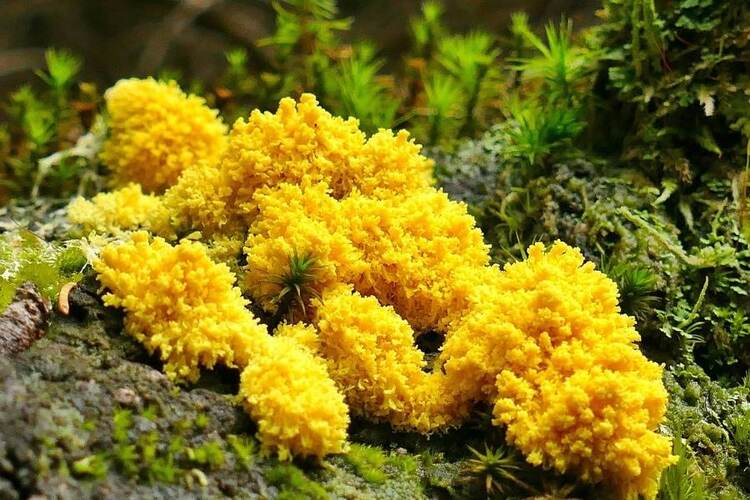
Yellow growth in a plant pot is not one single organism. It may be a harmless decomposer on damp potting mix, a yellow mushroom such as Leucocoprinus birnbaumii (flower pot parasol), a slime mold or even non-biological residue. Identifying its appearance and checking drainage are better first steps than spraying vinegar or baking soda.
What does the yellow material look like?
| Appearance | Possible explanation | Next step |
|---|---|---|
| Small bright-yellow umbrella-shaped mushrooms | Flower pot parasol (Leucocoprinus birnbaumii) is one possibility | Keep away from children and pets; review soil moisture |
| Fuzzy yellowish growth on surface organic debris | Decomposing fungi or other organisms | Remove decaying debris and improve watering/drainage |
| Yellow-orange irregular patches | May be a slime mold or another organism | Document it and seek identification if uncertain |
| Hard yellow/tan crust or granules | Could be minerals or old fertilizer pellets rather than mold | Check what was added to the pot and whether it dissolves or changes |
The appearance alone is not definitive. Do not eat, handle with bare hands and taste, or assume that a mushroom's color proves it safe.
Is the yellow houseplant mushroom harmful?
Penn State Extension describes Leucocoprinus birnbaumii as a decomposer of organic matter in potting soil that generally does not damage the plant. However, it can cause gastrointestinal illness if eaten, so remove visible mushrooms and keep the container out of reach of pets and young children. If ingestion is suspected, contact a veterinarian or poison-control professional rather than relying on a gardening remedy.
Why did it appear?
Potting mixes contain organic material such as bark, peat, coir or compost. Fungal spores may already be present or arrive later. Warmth, moisture and decomposing matter can favor visible growth. Persistent fungus gnats, waterlogged mix or an unpleasant smell are separate clues to check drainage and watering practices, not proof that a harmless mushroom caused root rot.
What to do in four steps
- Protect people and pets. Remove accessible mushrooms while wearing gloves and dispose of them safely where they cannot be eaten. Wash hands afterward.
- Check moisture. Feel below the surface, inspect drainage holes and empty standing water from saucers when appropriate for the plant.
- Remove loose debris. Pick up old leaves and visible surface growth; avoid scattering spores indoors.
- Change the conditions. Water based on the plant's needs rather than a fixed schedule, improve drainage and airflow, and repot in clean suitable mix if the medium is persistently waterlogged or unhealthy.
Should you pour vinegar, baking soda or fungicide on the soil?
Not as a routine response. Homemade acidic or alkaline mixtures can damage roots and do little to solve the moisture conditions that allow decomposers to thrive. Most healthy plants do not need fungicide simply because a saprophytic fungus is present. Seek a diagnosis before treating suspected disease and follow all product labels if a treatment is indicated.
When is repotting sensible?
Consider repotting if there is poor drainage, severe compaction, repeated root problems or a mixture contaminated with pests. University of Minnesota Extension recommends fresh, clean potting mix for indoor plant hygiene and new mix for seedlings. A single isolated mushroom in an otherwise healthy, well-drained pot is not always a reason to disturb the roots.
Takeaway: yellow mushrooms can be harmless to the plant but unsafe if ingested. Identify the growth, protect children and animals, and fix excess moisture rather than treating color alone as a disease diagnosis.