
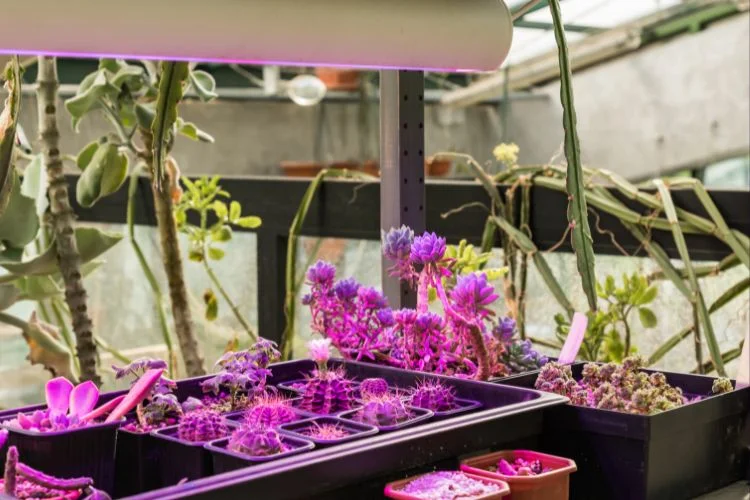
Most home seedlings and houseplants should have a consistent night period, not 24-hour lighting. More hours do not automatically mean healthier growth: the useful daily dose depends on light intensity and exposure, while some species need uninterrupted darkness for normal flowering.
Why plants need a day and night
Photosynthesis relies on light, but plants also have time-dependent growth and flowering responses. For home growers, a timer makes a predictable cycle easier than running lights around the clock. University of Minnesota Extension suggests approximately 16–18 hours of light for seedlings and 12–14 hours for many foliage houseplants, while some flowering plants respond to much more specific short- or long-day schedules. Controlled-environment growers may research unusual schedules for particular crops, but that is not a general recommendation for the windowsill.
A useful starting schedule
Seedlings often need a longer day than a mature shade-tolerant houseplant. Indoor lettuce and culinary herbs have their own needs; a pot already receiving several hours of window sunlight may need only supplemental lighting. Ask what the plant is, how strong the fixture is and how much natural light reaches its leaves before setting the timer. For a seed tray, extension guidance recommends sustained bright light and a dark interval; for holiday cactus or poinsettia, flowering may depend on nighttime darkness.
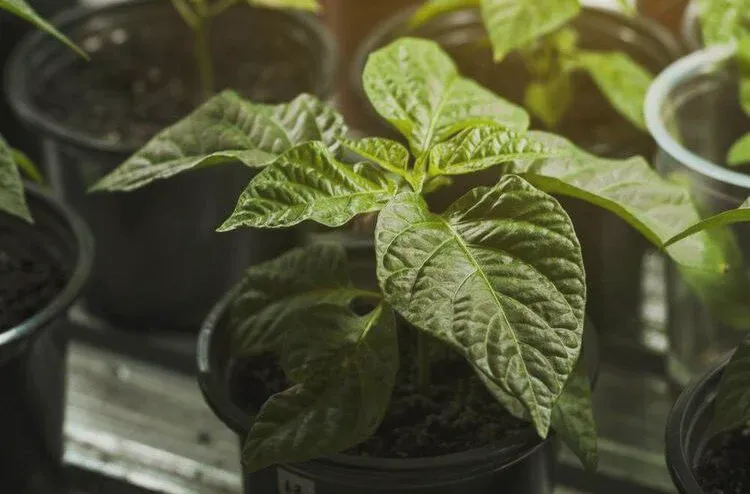
Photoperiod is only part of the dose
Purdue Extension defines daily light integral (DLI) as the total amount of photosynthetically useful light received in a day. For an approximately steady PPFD, DLI in mol/m²/day is PPFD multiplied by hours multiplied by 0.0036. Thus, a dim lamp used longer does not necessarily match a brighter one, and an intense panel left on too long may stress foliage. Manufacturers' canopy-height PPFD maps are more informative than judging color or wattage alone.
What to watch as plants respond
Pale or bleached leaves nearest a fixture can be a sign of excessive exposure, though poor roots and other stresses can produce similar symptoms. Long, weak stems and small leaves may point to insufficient light. Move or dim a fixture if canopy leaves bleach; improve distribution if plants stretch toward one side. A timer should provide stability while you assess new growth over weeks, not change wildly every day.
If the lights have been left on all night
Set an appropriate timer now; normalizing a day/night schedule generally requires no drastic pruning or repotting. Assess watering because plants in brighter conditions can use water differently than those in a shaded corner. Do not compensate for weak light by indefinitely extending the day; consider a better distributed or more efficient source. Keep equipment securely mounted and ventilated to avoid electrical and heat hazards.
Practical setup checklist
- Identify species and growth stage.
- Set a regular daylight window and nightly dark interval.
- Check PPFD or manufacturer coverage when possible.
- Observe upper leaves and new growth before changing settings.
References
Related: how far should grow lights be from seedlings · what size grow light do i need · can grow lights burn plants