
Size a grow light for the actual canopy area and the kind of plant, then compare measured PPFD maps at the height you can safely use. Do not start with a fixed watts-per-square-foot rule: two fixtures drawing the same power can deliver very different usable light. Plants also need different light doses depending on species and growth stage.
Measure the leaf canopy, not the room
Record the growing width and depth and estimate how large the plants will become. A four-foot-long shelf with one row of pots is a different shape from a square tent, even if the total area is similar. Check clearance for hanging hardware, driver and future growth. A bar can be appropriate for a narrow shelf; one board may fit a compact square area. If the light map has dim corners, use additional fixtures or adjust the layout rather than counting only the central hotspot.
Identify plant light demand
University of Minnesota Extension separates low-, medium- and high-light plants. Pothos and many other foliage plants need less intense light than seedlings of sun-loving vegetables or productive herbs. A lamp that keeps a snake plant alive may not grow strong tomato transplants. Account for existing window sunlight. If a plant is in a bright south-facing room, the supplemental fixture may run fewer hours than one supplying the entire daily light budget.
Use PPFD instead of marketing watts
Actual input watts help you calculate power bills, but photosynthetic photon flux density (PPFD, µmol/m²/s) estimates the useful light reaching leaf surfaces at a particular position. Seek manufacturer PPFD maps measured at a known height and dimmer setting. Look at the average and edge readings as well as the center peak. A fixture title such as '1000W' can be only a model name or an equivalency claim, not actual power drawn.
Calculate daily light integral
Purdue Extension explains that DLI is total photosynthetic light received over a day. For a steady PPFD, DLI (mol/m²/day) = PPFD (µmol/m²/s) × light hours × 0.0036. For example, 200 µmol/m²/s supplied for 14 hours gives about 10.1 mol/m²/day. This calculation assumes a constant measured PPFD and does not include changing sunlight. Species-specific targets are required to decide whether that is too little or too much.
Compare a compact board with a larger one
A documented 100 W VS1000-type board may be marketed for roughly 2-by-2-foot flowering coverage, while a 400 W VS4000-type board is intended for about 4-by-4 feet. These manufacturer claims illustrate why geometric scale matters, not a recommendation to buy either model without the actual light map. If you use a stronger fixture in a smaller space, dimming can help, but buying excessive power may waste money and require extra heat management.
Set height and duration
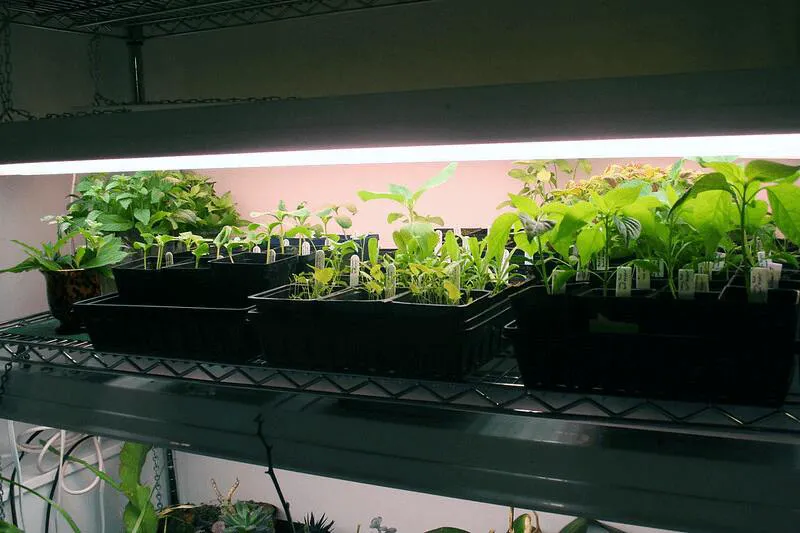
High-output LED panels may need substantial clearance, while ordinary fluorescent seed-starting bars often sit a few inches above leaves. Follow the individual fixture's distance instructions, not a universal distance based on technology alone. Use a timer that matches crop stage and day-length requirements. University of Minnesota Extension advises longer light periods for seedlings and other schedules for foliage or flowering houseplants. Some flowering species require uninterrupted nights.
Checklist before buying
Confirm canopy dimensions, intended plant category, real watts, PPFD at suitable distances, coverage uniformity and height adjustment. Include an electrical-safety rating, dry outlets, ventilation, warranty and any replacement controller. Estimate electricity as watts ÷ 1000 × hours per day; a 150 W fixture run for 14 hours would use 2.1 kWh per day at full power. That running cost is independent of whether the fixture provides adequate light.
Practical checks
- Match the source and spectrum to your actual crop and growing stage.
- Check PPFD at a stated distance instead of trusting an equivalency label.
- Use a stable light/dark schedule, and adjust only when new growth suggests it.
- Keep electrical fittings safely mounted and away from watering.
Credible sources
- University of Minnesota Extension — lighting guidance
- Purdue Extension — lighting guidance
- University of New Hampshire Extension — lighting guidance
Related guides: how to choose a grow light · types of grow lights · how far should grow lights be from seedlings