
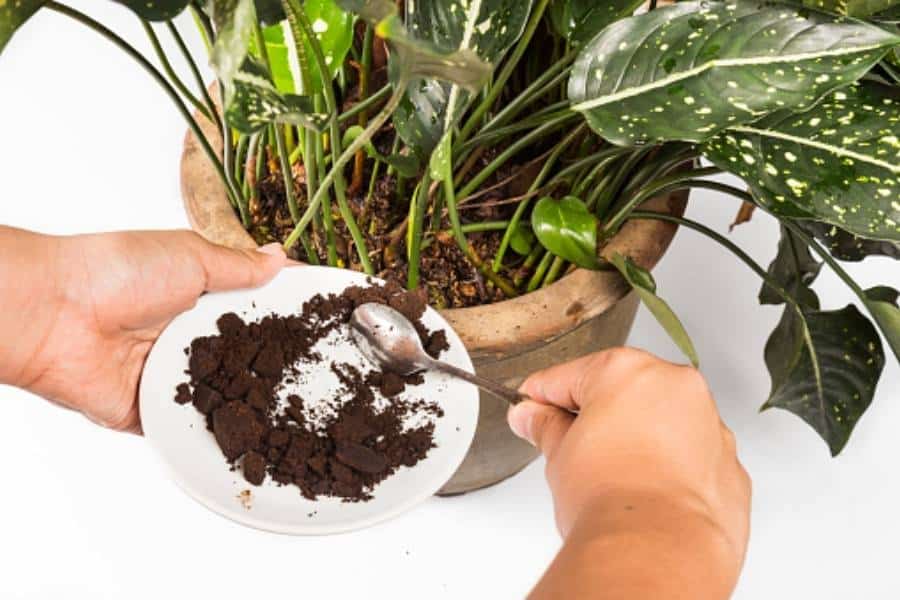
Used coffee grounds are better composted than mixed directly into a small succulent pot. Grounds can contribute organic matter, but they are not a balanced fertilizer and excessive amounts can interfere with roots or the potting mix. Succulents usually need drainage and light more urgently than kitchen scraps.
What used coffee grounds provide
Oregon State University Extension explains that spent grounds contain modest amounts of nitrogen and some other minerals, but not enough to be a dependable plant fertilizer. Decomposition can temporarily tie up nitrogen. This makes raw grounds a poor substitute for measured plant food. Claims of miraculous growth from adding repeated handfuls of coffee to pots are not supported by controlled guidance. Different succulent species and pot conditions add further uncertainty.
Do grounds make soil acidic?
After brewing, used coffee grounds are often much closer to neutral than the drink itself. Oregon State reports a typical pH near 6.5–6.8 and explains that they do not reliably acidify soil. Pouring leftover brewed coffee or using unbrewed grounds to force acidity is also poorly controlled, especially in a small container. Choose a suitable potting mix for the species rather than relying on coffee as a pH treatment. For general drainage see which plants can use cactus potting mix.
Why direct application is risky
Fine grounds may create a thick surface mat that affects moisture movement and aeration. When added heavily, undecomposed grounds may inhibit seed germination or root growth. These effects are especially inconvenient for cacti and succulents grown in small containers where excess retained moisture can contribute to rot. The Royal Horticultural Society recommends free-draining gritty media for most potted cacti and succulents, not a top layer of organic kitchen waste.
A better reuse method
- Collect used, unsweetened grounds and add modest amounts to a diverse compost pile.
- Mix them with dry leaves and other suitable compost ingredients, rather than dumping in one thick clump.
- Wait for the compost to mature into a uniform material before considering it for pots.
- Only add a small appropriate amount if the plant's mix can retain its air spaces and drainage.
- If a succulent is growing well, leave its potting mix alone rather than repeatedly experimenting.
What improves succulent growth more reliably?
Provide adequate light, choose a drained pot, identify the species and let its mix dry appropriately between waterings. University of Minnesota Extension stresses that cacti and succulents need ample light and modest water and fertilizer. Weak light can cause stretched growth; persistent sogginess can injure roots. These problems will not be solved by more coffee grounds. For plant size and growth see how big succulents get.