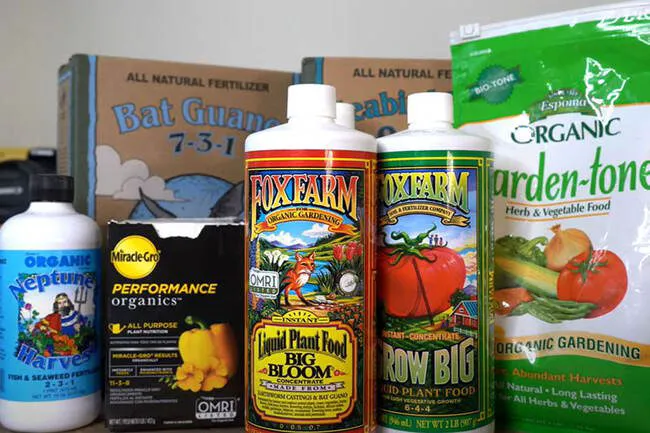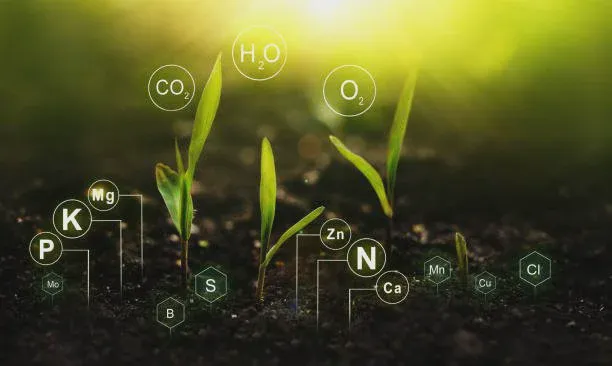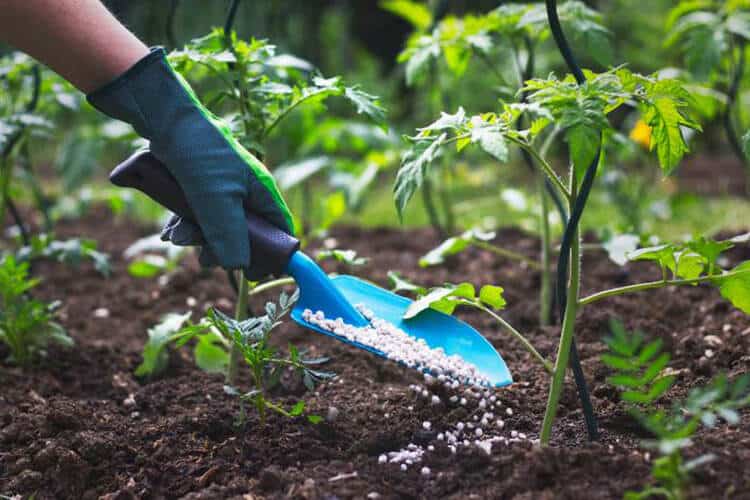
In gardening shops, 'plant food' is usually a marketing name for fertilizer. It does not mean a separate nutrient class. Plants manufacture sugars from carbon dioxide and water using light through photosynthesis; fertilizers supply mineral nutrients such as nitrogen, phosphorus and potassium when soil or growing media cannot provide enough.
Why the terminology confuses people
People often call nutrients 'food' because a nitrogen deficiency can make leaves pale and a nutrient application can support growth. Botanically, however, the energy-rich sugars produced by photosynthesis are a plant's food, while fertilizer provides chemical elements needed to build tissues and carry out metabolism. A bag labeled 'plant food' can still be ordinary fertilizer.
What does fertilizer actually contain?
The N-P-K numbers on the package describe nitrogen (N), phosphate (P₂O₅) and potash (K₂O) percentages by weight. Nitrogen supports proteins and chlorophyll, phosphorus participates in energy transfer and roots, and potassium is involved in water regulation and other functions. Plants also need calcium, magnesium, sulfur and smaller quantities of micronutrients. No single element replaces the rest.
| Product label | What to check |
|---|---|
| 'All-purpose plant food' | Actual N-P-K, micronutrients, use site and concentration |
| 'Bloom booster' | Whether additional phosphorus is actually needed; excess can be wasteful |
| 'Organic plant food' | Source materials, nutrient content and release rate |
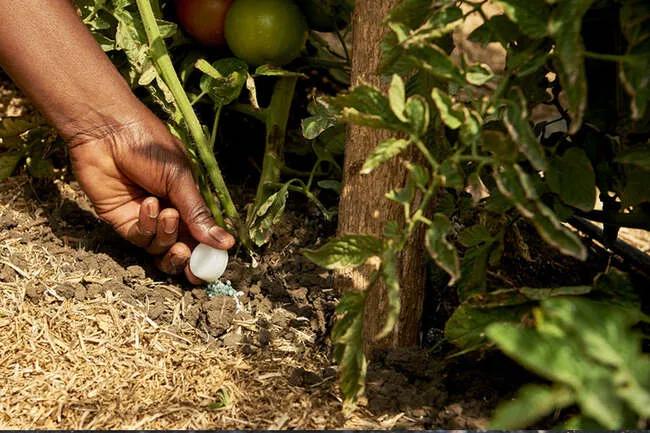
| 'Slow-release fertilizer' | How long the product is designed to release nutrients under suitable conditions |
Can a fertilizer replace light and water?
No. Good nutrition is only one factor. A plant with poor light cannot photosynthesize at its potential rate; overwatered roots may lack oxygen, and damaged roots may not absorb nutrients effectively. Adding more fertilizer to a stressed plant can raise soluble salts and worsen the problem.
Is compost plant food?
Compost contains variable nutrients and organic matter, but it is usually better treated as a soil amendment than a complete, precisely dosed feed. A test can show whether your garden also needs a measured fertilizer application. Oregon State University Extension notes that compost's fertilizer value is typically lower than concentrated mineral fertilizers even though it provides valuable soil benefits.
How to choose a product without getting misled
- Ignore vague 'feeds everything' or miracle-growth slogans and turn the bag over.
- Read N-P-K, dilution or area-rate instructions, plant suitability, application interval and safety warnings.
- Use a soil test for outdoor soil when possible; consider the contents of any pre-fertilized potting mix.
- Apply only what is needed during an appropriate growth period. Watch actual plant condition before repeating.
Frequently asked questions
Do houseplants need plant food every week?
Not automatically. Some potting mixes already supply nutrients, and houseplant demand depends on species, light, season and watering. Follow the particular product's dilution and interval rather than a universal weekly schedule.
Does 'natural plant food' mean zero risk?
No. Organic products can still add excess nutrients, salts or undecomposed materials, while raw manure may carry food-safety concerns. Match material to the plant and use it correctly.
In short, 'plant food' on packaging typically means fertilizer; healthy plant growth also depends on energy from light and adequate roots, water and air.