
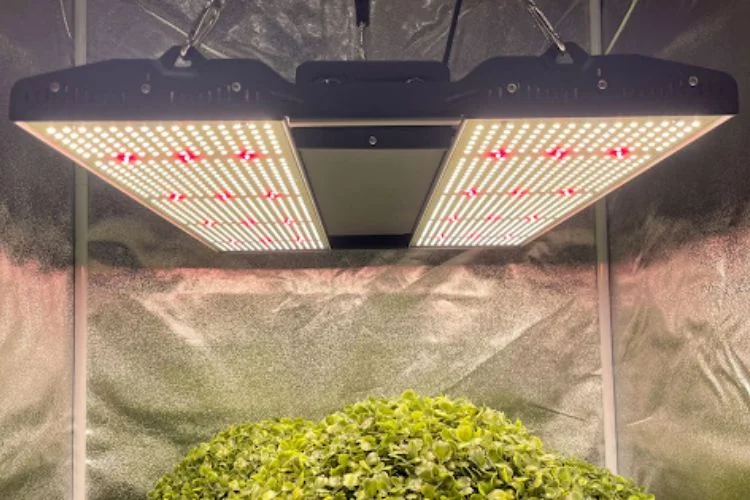
Medic Grow offers higher-output LED fixtures for indoor growing spaces. MiniSun-2 and Spectrum X belong to different output and control categories; the brand name alone cannot tell you whether a fixture fits your plants. Use manufacturer model-specific data and compare your actual growing footprint.
The MiniSun-2 range
The manufacturer's MiniSun-2 specification sheet identifies versions at 150 W, 240 W, 320 W and 500 W. The listed 320 W version produces 896 µmol/s PPF, while a separately named 320 W Plus is specified differently. Confirm the suffix as well as the number on the lamp; different versions do not automatically share light output or driver features. Compare the canopy PPFD map at the mounting height you intend to use.
The Spectrum X option
Medic Grow's Spectrum X specifications list a large 780 W light and an 880 W configuration that includes additional UV/IR bars, with a roughly 5-by-5-foot coverage claim. That class of fixture is not comparable with a small plant bulb or seed-starting strip. Optional ultraviolet accessories require careful adherence to manufacturer safety instructions; do not add UV on the unsupported assumption that all indoor plants need it.
Controls and practical compatibility
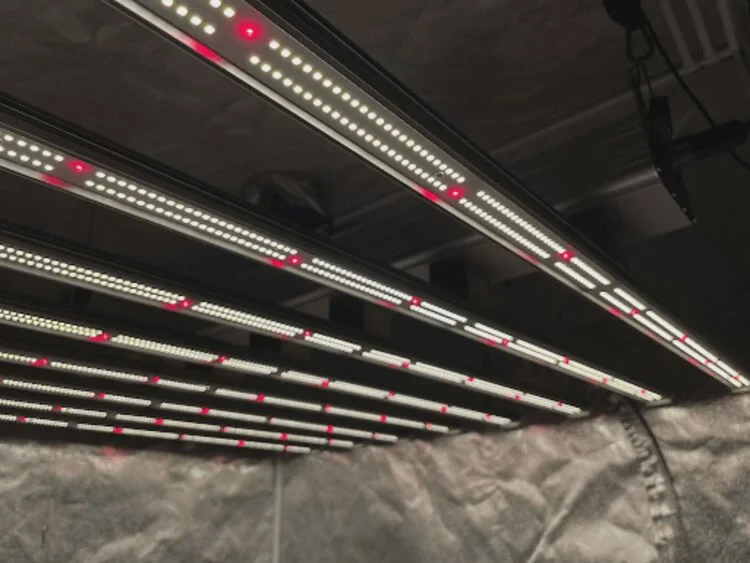
The MiniSun-2 sheet describes built-in dimming and timer functions; the Spectrum X line uses a different channel arrangement. Medic Grow notes that not every controller works across its families. Check which driver, controller and linking arrangement the exact SKU accepts. Also assess power-cord length, net weight, airflow and adequate ceiling clearance before buying. Product photos cannot establish mounting safety.
Light needs determine the purchase
University of Minnesota Extension distinguishes low-light foliage plants from high-light herbs, citrus and flowering crops. A large commercial-scale fixture is inefficient and sometimes too intense for a few ordinary houseplants. More watts do not prove better yield. Match the manufacturer PPFD footprint and expected daily light exposure to the particular crop; use dimming and a timer to avoid unnecessarily intense exposure.

What this review can establish
Published documentation supports comparisons of named versions, power ratings and stated features. It does not establish real-world yield, durability or whether a particular revision will remain in stock. Confirm return arrangements, warranty terms, safety certifications for the exact model and any mandatory controllers directly with the seller. These are specification-based observations, not a claim of personal fixture testing.
Before choosing a fixture
- Identify the crop and plant canopy dimensions before looking at model numbers.
- Confirm the exact wattage, PPFD map, safe hanging height and electrical rating.
- Check the genuine warranty and controller or accessory compatibility.
- Follow an appropriate light/dark schedule and monitor new growth.
Sources and further reading
- medicgrow.com — published product details or growing guidance
- medicgrow.com — published product details or growing guidance
- extension.umn.edu — published product details or growing guidance
Related guides: how to choose a grow light · vivosun grow light review · viparspectra grow light review