
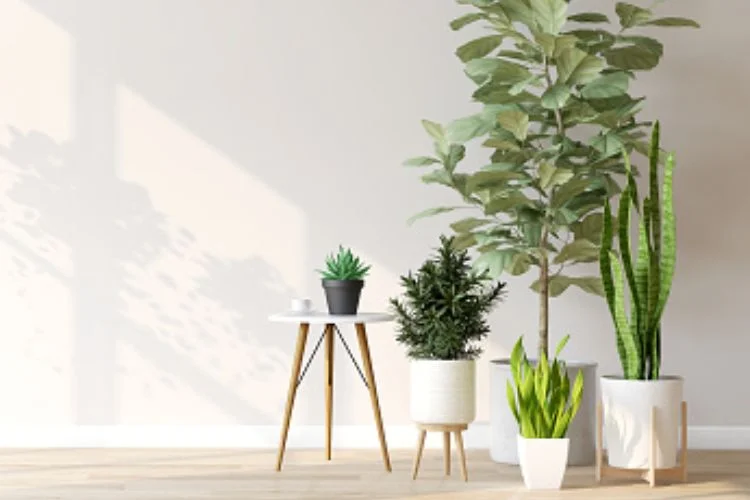
Choose a fiddle-leaf fig pot with a drainage hole, a broad stable base and enough space for healthy roots without a large ring of permanently wet potting mix. A heavy glazed ceramic pot or a draining plastic nursery pot inside a stable decorative planter can work well for a tall tree. The best material depends on how quickly the potting mix dries in your home—not on appearance alone.
Fiddle-leaf figs (Ficus lyrata) prefer bright indirect light and well-drained growing conditions. Their large leaves and upright stems can make them top-heavy, particularly as they mature. A pot that tips easily is a practical hazard, while an oversized one may keep too much mix wet around the roots. A wide-based planter is often a better choice than a narrow decorative vessel of the same capacity.
Compare your options
| Option | When it fits | Advantage | Limitation |
|---|---|---|---|
| Plastic nursery pot with drainage | Plant grown indoors or inside a cachepot | Light, easy to lift, moisture tends to last longer | Needs a stable outer pot for a taller specimen |
| Unglazed terracotta | Bright, warm room where the mix stays wet too long | Porous walls help moisture evaporate | Needs more frequent moisture checks; may be heavy |
| Glazed ceramic with drainage holes | A plant displayed openly on the floor | Often stable and attractive; less porous than terracotta | Can be heavy and awkward to move; check drainage first |
| Decorative cachepot without holes | Matching home décor while keeping reliable drainage | Allows a draining nursery pot inside | Never leave collected water around the inner pot |
How large should the next pot be?
Move up only when the root ball needs it. Iowa State Extension recommends increasing one container size, or at most two, rather than moving a small root system into an enormous planter. Check for roots circling densely, emerging through holes, or a potting mix that dries unusually fast. A plant that merely looks tall does not automatically need the largest available pot. Choose diameter based on the root ball and stability based on the height and spread of the foliage.
Pot material changes watering
Unglazed clay allows more evaporation, whereas plastic or glazed containers often retain moisture longer. Neither material guarantees healthy roots if the pot lacks drainage or the mix is compacted. If you change from terracotta to plastic, start checking moisture instead of repeating your old watering schedule. Protect flooring with a saucer, then empty it after watering.
Drainage is not a gravel layer
A pot must have drainage holes or be used as an outer decorative sleeve around a draining inner pot. Putting gravel or rocks in the bottom does not turn a solid pot into a well-draining container. Iowa State Extension advises against this because it can leave a wetter zone closer to the roots. Use suitable indoor potting mix and keep the plant at its existing planting depth.
Practical steps
- Check whether the tree is actually rootbound and inspect the current root ball rather than judging from leaf height.
- Select a container only one size larger if the roots have filled the existing pot. Use a wide, stable base for a top-heavy plant.
- Place a small amount of fresh houseplant potting mix in the bottom; avoid a layer of rocks.
- Loosen tightly circling roots gently, keeping as many healthy roots intact as possible. Set the plant at the previous soil depth.
- Fill gaps around the roots, water thoroughly and allow the pot to drain fully before returning it to a cachepot or saucer.
- Check moisture over the next few weeks as the root system settles, especially if the material and pot size changed.
Frequently asked questions
Does a fiddle-leaf fig require a terracotta pot?
No. Terracotta may help excess moisture evaporate, but plastic and glazed ceramic can work when the mix drains well and watering is adjusted to conditions.
Can I plant directly into a decorative pot without holes?
It is safer to keep the plant in a nursery pot with holes and use the solid decorative pot only as a cover. Empty excess collected water promptly.
Why does the tree tip over after repotting?
Its foliage may be heavy relative to the base. Choose a wider and more stable outer pot; avoid solving a stability problem solely by using an enormous volume of potting mix.
References and related guides
- Iowa State University Extension — How to Care for Houseplants
- Penn State Extension — Repotting Houseplants
- NC State Extension — Fiddle-leaf fig
- Fiddle-leaf fig potting mix
Affiliate disclosure: Some links on Swipe Garden may earn a commission from qualifying purchases.