
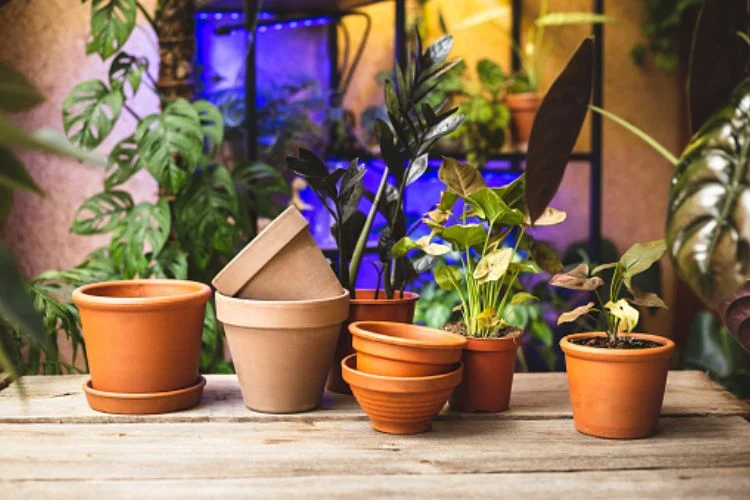
A good Monstera pot drains freely, fits the current root ball and stays stable as the foliage spreads or climbs. Most plants do well in a nursery pot with drainage holes; a heavier or broader container becomes useful for a large Monstera trained up a support. Do not move a small root system into an oversized decorative pot just because its leaves are broad.
Monstera develops thick roots, aerial roots and large leaves, but aerial roots alone do not prove that the plant needs repotting. Check the roots inside the container and the condition of the mix. Penn State Extension recommends a well-draining, organic-rich soilless medium. Root aeration, drainage and support stability matter more than a special pot branded for Monstera.
Compare your options
| Option | When it fits | Advantage | Limitation |
|---|---|---|---|
| Draining plastic nursery pot | Small and medium Monsteras | Light, affordable, easy to inspect and repot | May need a heavier outer planter to prevent tipping |
| Unglazed terracotta | A room where the mix stays wet too long | More evaporation through the pot walls | Heavier; may require more frequent watering |
| Wide-based ceramic planter with drainage | Large Monstera with a climbing pole | Sturdy footprint for broad foliage and pole support | Heavy to move; verify the hole is not blocked |
| Nursery pot inside a decorative cachepot | Decorative display and flexible care | Provides proper drainage without giving up appearance | Inner pot must be removed or drained after watering |
Size the pot to roots, not leaves
Aerial roots and split leaves can make a Monstera look larger than its underground root ball. Lift the plant to see whether roots are dense, circling or escaping through drainage holes. If repotting is needed, Iowa State Extension recommends increasing only one or two pot sizes. Oversized pots hold a greater volume of damp mix and may dry slowly.
Make room for a support pole
A climbing Monstera may need a moss pole, plank or other secure support. Plan for where the support will sit without damaging roots or blocking drainage holes. A tall pole attached to a tiny lightweight pot may make the setup unstable. For a large plant, use a broad, heavier draining container or place the nursery pot inside a stable outer planter.
Drainage and watering work together
Penn State Extension suggests thorough watering followed by allowing the upper layer of mix to dry between sessions. A draining pot, free-draining medium and careful watering all play roles; no material fixes a persistently wet root zone. Plastic retains moisture longer than unglazed clay in many indoor settings, so reassess your routine when changing pots.
Practical steps
- Check the root mass and decide whether the plant truly needs a larger container or only a stronger support.
- Choose a draining pot just one size larger when the root system is crowded, with a broad base if the plant climbs.
- Fit the support securely before packing in all the mix, taking care not to force it through major roots.
- Place the plant at its previous depth in a well-draining soilless potting mix; fill gently without excessive compression.
- Water fully, drain completely, and return the pot to a cachepot only after excess water has escaped.
- Recheck stability as new leaves unfurl and climbing stems gain weight; reposition ties rather than damaging the stem.
Frequently asked questions
Does a Monstera need a moss pole?
Not every Monstera does, but climbing forms often benefit from support if you want an upright growth habit. The pole and pot should be stable together.
Are aerial roots a sign that the pot is too small?
Not by themselves. Aerial roots are normal for Monstera. Inspect the underground root ball and drainage behavior before choosing a larger pot.
Is a self-watering pot best for Monstera?
It can be workable for experienced growers who monitor roots and moisture, but a continually wet reservoir is not automatically helpful. Start with reliable drainage and a suitable mix.
References and related guides
- Iowa State University Extension — How to Care for Houseplants
- Penn State Extension — Monstera as a Houseplant
- Penn State Extension — Repotting Houseplants
- Monstera fertilizer guide
- Monstera light requirements
Affiliate disclosure: Some links on Swipe Garden may earn a commission from qualifying purchases.