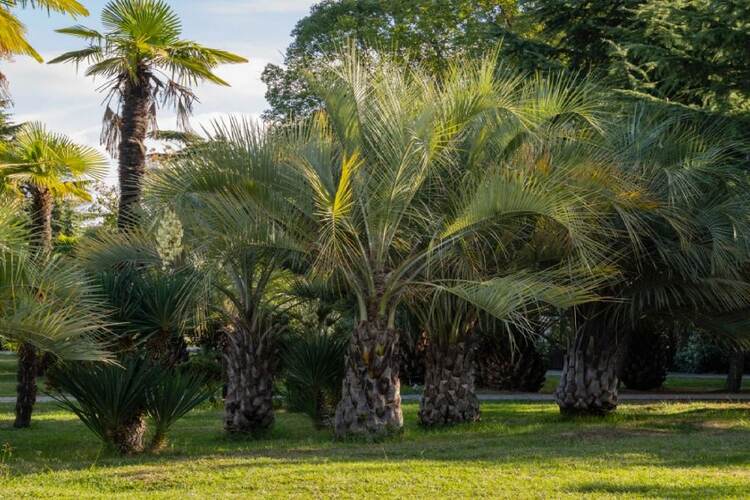
Some palm fertilizers can be used on nearby ornamental trees and shrubs, but they are not automatically appropriate for every plant. Check the product label, nutrient analysis, release type and soil test before using one outside its intended crop. Never assume a palm blend is a safe substitute for food-crop fertilizer or a product designed for acid-loving plants.
What makes palm fertilizer different?
Landscape palms, particularly in Florida's sandy soils, can be prone to potassium, magnesium, manganese and other nutrient deficiencies. UF/IFAS describes balanced, controlled-release palm formulations commonly around 8-2-12-4Mg plus appropriate micronutrients for those settings. That does not mean all palms worldwide, or every other plant, require this exact ratio.
The numbers on a fertilizer bag describe the percentages of nitrogen, available phosphate and potash; a fourth Mg value may denote magnesium. Slow-release sources matter because readily soluble nutrients can be washed out of sandy soils.
When sharing a palm fertilizer makes sense
UF/IFAS notes that appropriately formulated landscape palm fertilizers may also be suitable for ornamental plants growing in the same landscape. A mixed bed of palms and compatible shrubs may benefit from coordinated fertility management when a soil test, local extension guidance and the label agree. It is still necessary to calculate the total dose and avoid fertilizing the same shared root area twice.
When to use a different fertilizer
- Vegetables and herbs: use a product explicitly labeled for edible crops, without added lawn herbicides or other unapproved ingredients.
- Container plants: small root volumes make overapplication easy; follow container-specific label instructions.
- Acid-loving plants: soil pH management may be more important than the fertilizer's name.
- Plants with adequate nutrients: skip unnecessary applications. Adding minerals without a deficiency can create imbalance.
- Cold-stressed or waterlogged plants: fix environmental problems first.
How to use a palm blend without harming a garden
- Read the entire label, including plants, locations, dose, frequency and watering instructions.
- Review a recent soil test and local extension recommendations.
- Calculate the amount of actual nitrogen and avoid double-counting overlapping root zones.
- Distribute granules over the intended root area as the label requires, never in a pile beside a trunk or stem.
- Observe plants over new growth cycles; older damaged leaves may never look normal again.
If your goal is to fertilize a palm itself, use the palm application guide. For edible beds see why lawn products require a separate label check.
Bottom line
Sharing a fertilizer is possible when the plant, soil and label requirements line up. The words “palm fertilizer” are not proof of universal suitability, and more potassium or magnesium is not always better.