
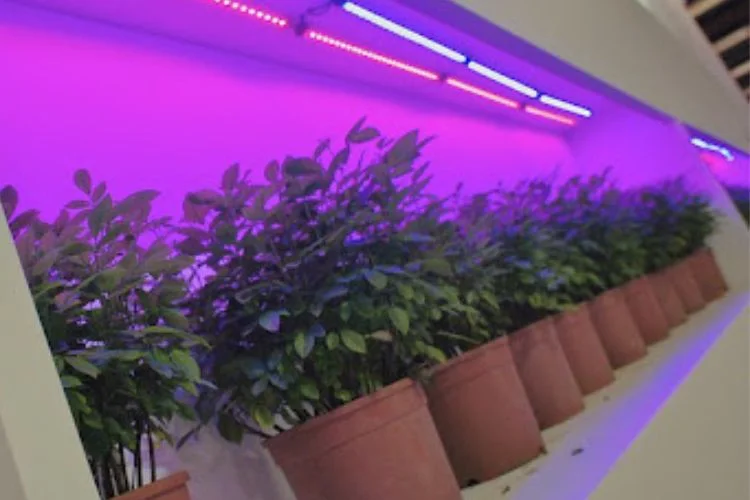
Both purple and white LED grow lights can grow plants when they provide enough usable photons. Purple fixtures mix strong red and blue emissions; white-looking fixtures deliver a broader visible mixture. For most home growers, balanced white is convenient because foliage colors remain recognizable. Compare measured PPFD and DLI, not perceived color alone.
What makes a grow light purple?
A red/blue fixture emits strong peaks in red and blue wavelengths, and our eyes interpret their mixture as pinkish purple. Chlorophyll absorbs light strongly in parts of these bands, but plants also use other visible wavelengths. A light emitting mostly red and blue is not inherently more effective than a quality white LED. Some white fixtures include extra red diodes; the emitted spectrum varies by product. The meaningful question is how many photons reach the leaves at the right times.
Advantages of white light
White LED light is more pleasant for many occupied rooms, and it makes yellow leaves, pests or other visual problems easier to notice. University of Minnesota Extension considers mixed or white/balanced lamps suitable for most growing stages. White LEDs can be efficient and available as bulbs, bars and panels. A common household LED may still be too weak for seed starting, however, because white color does not guarantee high PPFD.
Advantages and limits of purple lighting
Red/blue arrangements can be optimized for particular horticultural uses and are common in specialized growing systems. Their purple appearance makes assessing natural foliage color difficult and may be unpleasant in a living area. Fixture efficiency also depends on diode technology, optics, drive current and output. It is incorrect to assume purple lamps work only for seedlings or that white lamps cannot promote flowering. Compare complete spectral and photon-output information for the actual product.
Intensity, coverage and photoperiod matter more
Use canopy PPFD maps at the intended hanging height and assess the whole illuminated footprint. A fixture with a bright middle and weak edges may grow an uneven tray, regardless of color. Purdue Extension explains daily light integral (DLI), which combines photons received per second with the lighting duration. For a steady PPFD, DLI is PPFD × hours × 0.0036. A poor bulb cannot become a powerful horticultural fixture merely by glowing purple.
Choosing for your room
For one or more decorative foliage plants, start with a suitable balanced white LED and check whether the whole canopy receives useful light. For larger seedling or flowering systems, compare quality horticultural fixtures of either spectrum, with credible measurements and safe mounting. Watch for leaf stretching under weak lighting and bleach under excessive intensity. Use a consistent day/night schedule appropriate to the species.
Practical checks
- Match the source and spectrum to your actual crop and growing stage.
- Check PPFD at a stated distance instead of trusting an equivalency label.
- Use a stable light/dark schedule, and adjust only when new growth suggests it.
- Keep electrical fittings safely mounted and away from watering.
Credible sources
Related guides: why are grow lights purple · grow light vs regular light · how to choose a grow light