
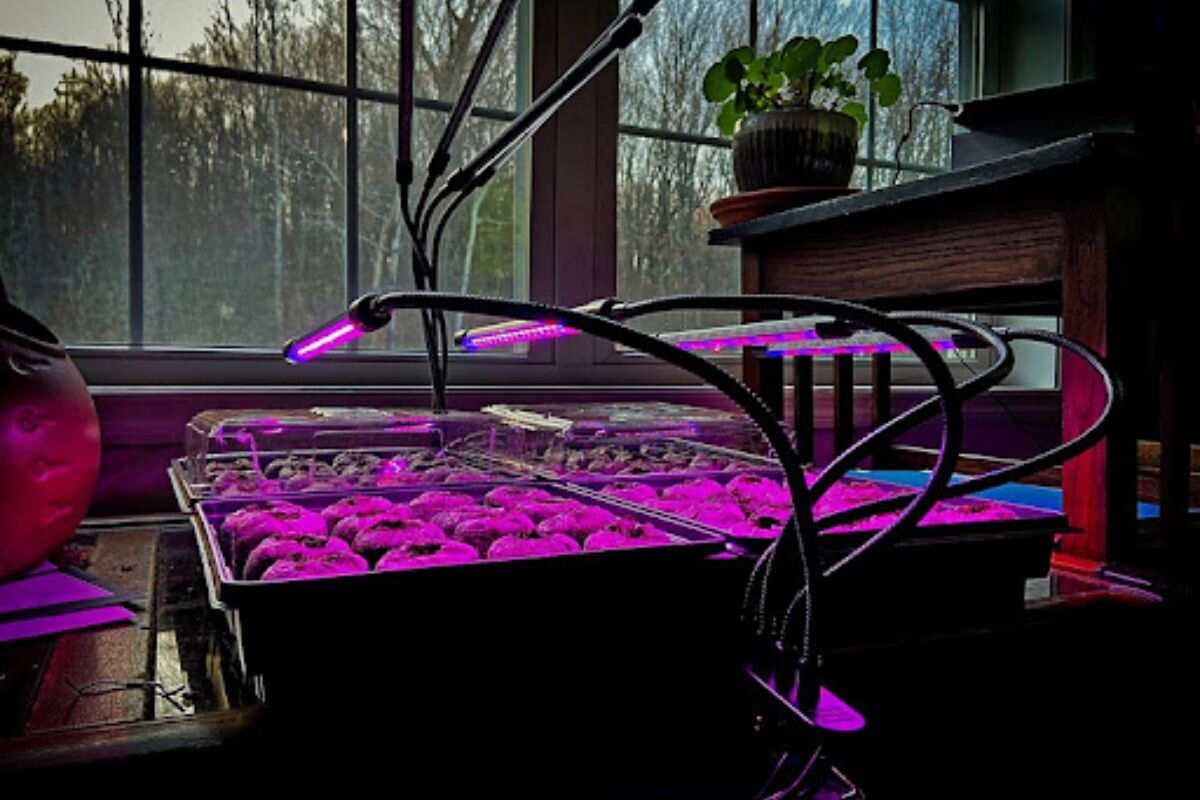
Some grow lights look purple because they combine red and blue LED emissions; our eyes perceive the mixture as magenta or violet. This does not mean plants need purple light specifically. Balanced white grow lights can also support photosynthesis, and the amount of usable light reaching leaves matters more than the fixture's apparent color.
The red-and-blue explanation
Plants' photosynthetic pigments absorb light strongly in red and blue regions, which helped make early red/blue LED fixtures common in horticulture. When a lamp emits strong red and blue wavelengths with less green, it looks purple to a person. This is not necessarily a single violet wavelength, nor does the glow guarantee high output. A fixture with inadequate intensity cannot be made effective simply by using purple diodes.
Do plants also use green and white light?
Yes. Plants use photosynthetically active wavelengths across the visible range, not only red and blue. A white LED includes many wavelengths useful for photosynthesis. University of Minnesota Extension recommends white or mixed/balanced light for a broad range of plants and growing stages. Green wavelengths can penetrate deeper into some canopies and have roles in plant responses, so slogans about green light being completely wasted are misleading.
Why white grow lights are popular
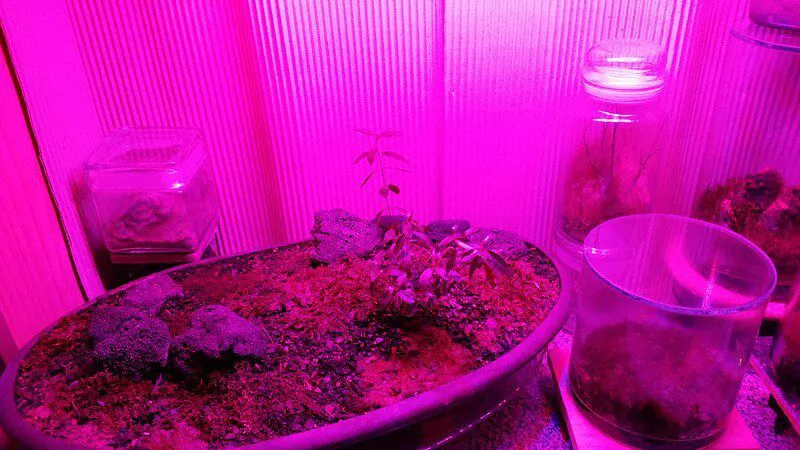
A white-looking LED is easier to live with in kitchens and rooms, where continuous purple illumination can feel unnatural. Balanced light also lets gardeners recognize yellowing, pest damage and leaf color changes. Manufacturers may include additional red LEDs in a white fixture for horticultural performance; the details vary. A measured spectrum chart and PPFD map tell you more than a photograph showing a white or purple glow.
Is purple better for seedlings or flowers?
No simple color rule applies to every crop. Plant responses depend on spectrum, species, growth stage and total light supply. Red-rich lighting may influence certain growth or flowering responses, while blue light often affects compactness, yet both need to be considered with the whole spectrum and environment. Use manufacturer PPFD maps and a suitable daily light integral instead of automatically changing bulbs when seedlings become mature plants.
What to check when buying
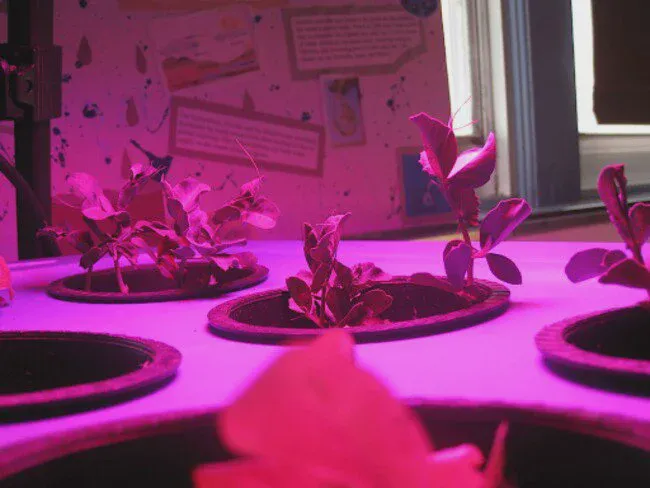
Compare canopy coverage, actual power draw, PPFD at your hanging distance, dimming and mounting safety. Purple LEDs may have niche advantages in controlled production, but household foliage and seed trays can grow under appropriate white LEDs too. Protect eyes from intense lamps and do not stare into a bright diode array. Follow a regular light/dark schedule for the species rather than trying to compensate for a weak fixture with 24-hour exposure.
Practical checks
- Match the source and spectrum to your actual crop and growing stage.
- Check PPFD at a stated distance instead of trusting an equivalency label.
- Use a stable light/dark schedule, and adjust only when new growth suggests it.
- Keep electrical fittings safely mounted and away from watering.
Credible sources
Related guides: purple vs white grow light · how to choose a grow light · grow light vs sunlight