
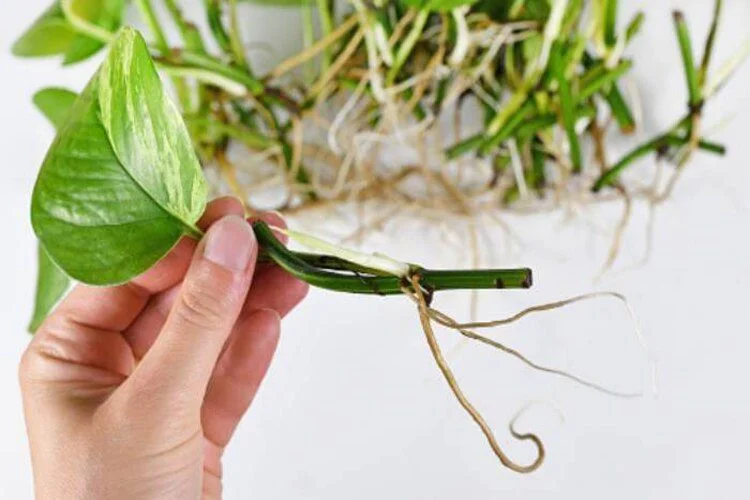
Quick answer: A root-bound pothos has roots crowded inside its container. It may dry unusually quickly, stop growing or send many roots through drainage holes, but one visible root does not prove a problem. Slide the root ball out gently to assess crowding and repot only when the plant needs more room or better medium.
What real root crowding looks like
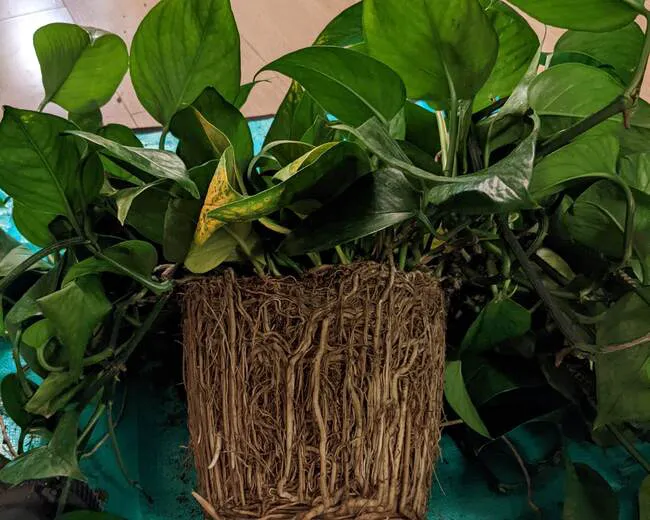
A tightly circling root mass with little remaining mix, roots coiling around the bottom, and difficulty absorbing water all suggest the plant may have outgrown its pot. Root crowding is not identical to aerial roots growing along stems. Pothos tolerates some pot confinement, and a healthy plant in a small container may continue growing without emergency repotting.
When it is time to move up
Look for repeated rapid drying despite thorough watering, the mix breaking down, or persistent stalling combined with densely packed roots. Iowa State Extension advises matching pot size to the root ball rather than choosing the biggest container available, because too much wet mix encourages rot. Repotting is usually easier during active growth, but an urgently failing medium can be addressed at other times.
Step-by-step repotting
Water slightly beforehand if the medium is extremely dry, then ease the root ball out without pulling on the stems. Check for dead roots and loosen tight outer coils gently; avoid cutting large healthy portions. Choose a clean pot only slightly wider than the current root mass with an unobstructed drainage hole. Fill with fresh airy houseplant mix and keep the plant at its former soil depth. Water well and allow complete runoff.
Aftercare and fertilizer
Keep newly repotted pothos in bright filtered light and avoid abrupt heat or light changes. Recheck moisture; the new mix may behave differently from the old. Do not add heavy fertilizer immediately, since many commercial mixes already contain some. Slight temporary drooping can follow disturbance, but persistent wilting with wet soil calls for reassessing root damage.
Can you divide or root cuttings instead?
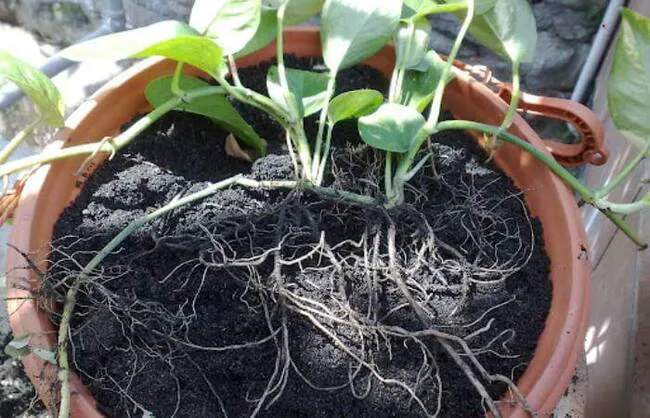
Several vines can be gently separated only when their roots can be disentangled without severe damage. If the root ball is tightly fused, it may be easier to repot intact and take stem-node cuttings for another container. Clean tools before trimming and avoid cutting every root on an arbitrary annual schedule.
Frequently asked questions
Should I repot every year?
No. Check root crowding and medium performance instead of a fixed timetable.
Can I put gravel in the bottom?
No. Gravel does not make a poorly draining pot safe and may worsen a perched wet zone.