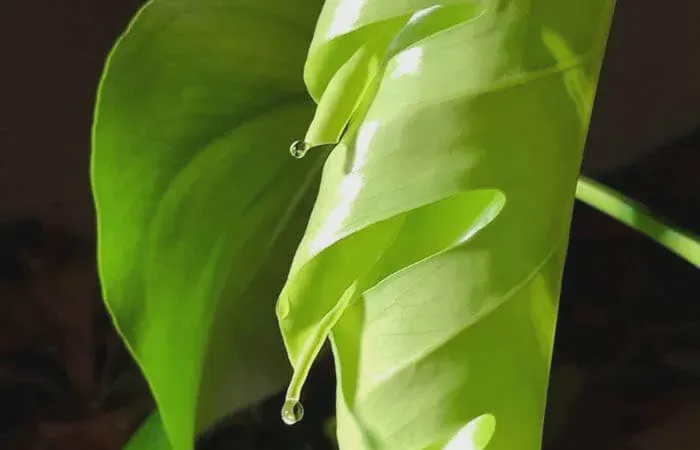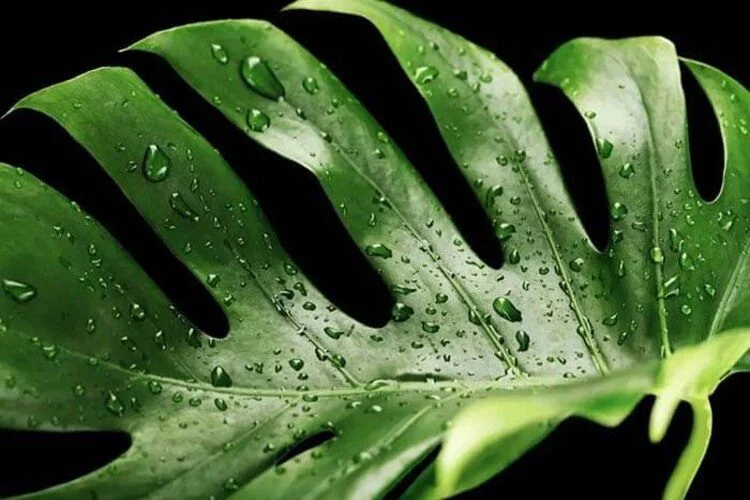
Clear droplets that appear at the edges or tips of Monstera leaves—often overnight or early in the morning—are commonly guttation. Healthy plants can release liquid through small openings called hydathodes when root pressure is high and evaporation from leaves is low. On its own, this does not prove overwatering, illness or a need for fertilizer.
First check exactly where the moisture forms
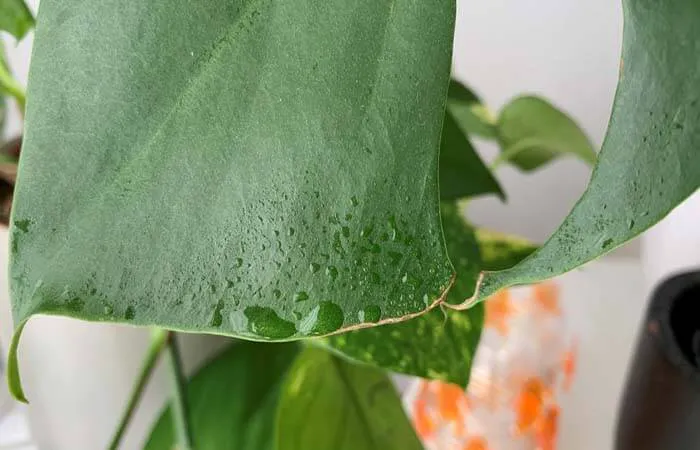
Individual drops repeatedly collecting at particular leaf margins fit guttation. A fine film across a cool leaf in a humid room may be condensation. Residual spray after misting or overhead watering can also leave obvious surface droplets. Watch the location and timing of the drops before changing anything. Guttation is liquid released through the plant; transpiration is water vapor that usually leaves the surface without forming visible drops.
Why guttation happens overnight
Plants can continue absorbing water through roots when nighttime transpiration falls. Positive pressure can build in the xylem, pushing dilute sap toward specialized hydathodes near leaf margins. The exuded liquid may carry trace minerals and leave a light residue when dry. University of Missouri explains that this releases root pressure and is a normal plant process. Weather, humidity and root-zone moisture affect how often it occurs.
Does dripping prove your Monstera is overwatered?
No. A plant with healthy roots and draining mix may guttate after an ordinary watering. Look for separate warning signs: soil that stays soaked for long periods, persistent yellowing, soft stems, sour-smelling roots or a severely heavy pot. If foliage stays firm, new growth is healthy and water drains freely, do not repot or dry the roots excessively just to stop the drops. When clear evidence of root trouble occurs, use the Monstera overwatering guide.
Could the liquid be sticky insect honeydew?
Sticky residue on stems, undersides or furniture may come from sap-feeding insects, particularly soft scale. Examine sheltered leaf veins and petiole bases for stationary brown bumps, crawlers or sooty mold. Honeydew can collect away from leaf tips, while normal guttation tends to be at specific margins. Neither slight stickiness nor one drop confirms an insect, so look for the pest itself before treatment. For verified pests, see identifying scale on Monstera.
What to do when leaves keep dripping
- Check the potting mix below the surface before watering again.
- Confirm that drainage holes work and the pot is not sitting in runoff.
- Maintain bright filtered light and gentle ventilation without cold drafts.
- Wipe drops off a shelf or floor when necessary, but do not use household cleaners on the leaf.
- Watch foliage and roots. If they are healthy, there is no reason to treat ordinary guttation.
What not to assume
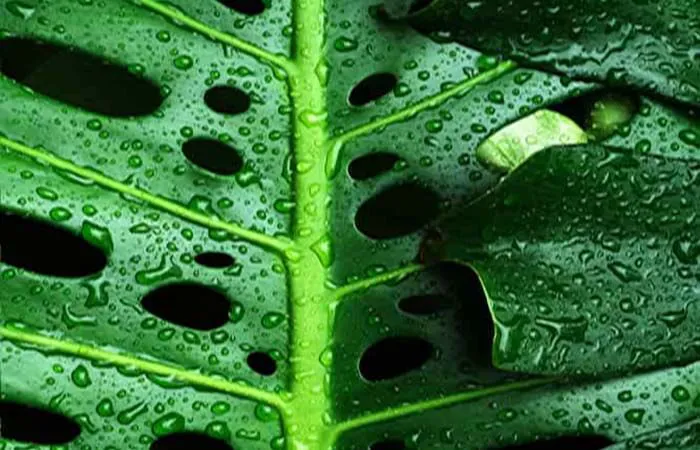
Dripping does not prove the plant is especially healthy or especially sick; it is simply one water-transport response. Extra fertilizer will not solve it, and a dramatic shift into direct sun may scorch leaves. Moisture alone does not prove a fungal infection, so avoid preventative pesticide sprays without a diagnosis. If pets chew Monstera foliage, keep the plant out of reach regardless of whether it has water droplets.
Sources and next steps
Read University of Missouri's explanation of guttation and hydathodes and Iowa State Extension's watering and drainage guidance. For a deeper comparison of droplets, dew and transpiration see why Monstera appears to sweat, or review why leaves droop.