
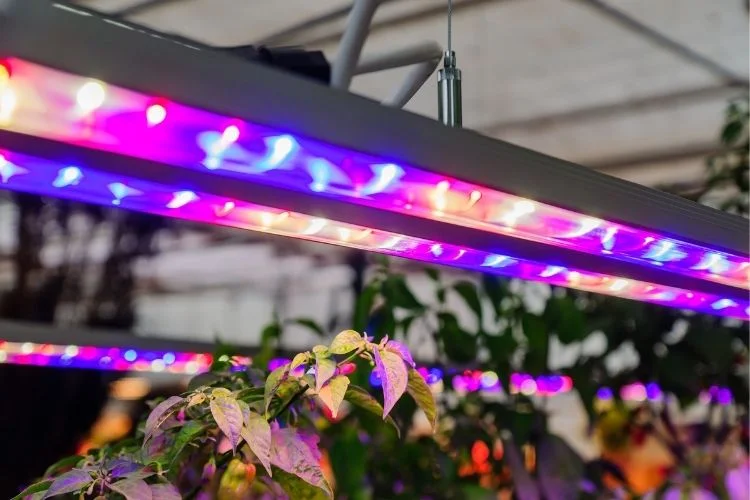
Both fluorescent tubes and LED grow lights can support indoor plants. LEDs are usually preferable for a new installation because of energy efficiency, longevity and available output options. A functioning fluorescent shop-light system is still useful for seedlings or a small shelving unit when mounted correctly.
Electricity and useful light
An LED grow fixture may deliver more photosynthetic photons per watt than a typical fluorescent lamp, but performance must be checked model by model. The wall-plug watts indicate operating cost; PPFD maps show the amount reaching the plants. Comparing wattage alone cannot establish an expected harvest. Purdue Extension emphasizes daily light integral, which accounts for both intensity and lighting duration. A strong lamp run at a sensible schedule may outperform a weaker one operating longer.
Coverage of seedlings and houseplants
Linear fluorescent shop lights spread light over a tray and work well near the tops of young seedlings. LED bars can do the same; LED boards or spot bulbs serve different footprints. A high-output horticultural panel may need more hanging distance and a dimming setting than an inexpensive fluorescent tube. The best shape depends on whether you have one pot, a wide propagation shelf or tall plants needing strong overhead coverage.
Temperature and maintenance
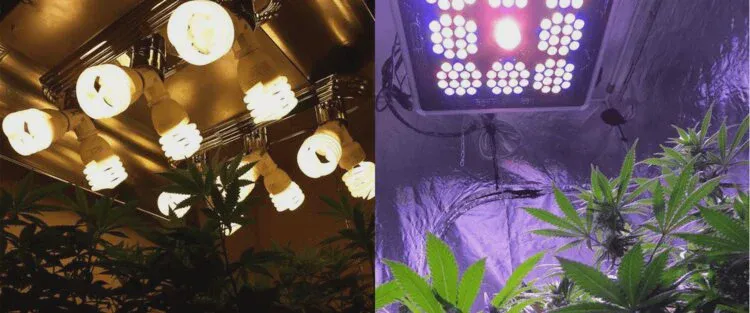
Fluorescents produce heat and need compatible ballasts and replacement tubes. LEDs also warm their housing or driver but usually reduce radiant heat close to leaves compared with high-temperature HID sources. Check whether a particular LED is rated for an enclosed shelf and whether its ventilation paths remain clear. Any fluorescent tube containing mercury needs careful disposal; a broken tube should not be swept up like ordinary glass without following local guidance.
Spectrum and plant health
Balanced white lamps and red/blue horticultural fixtures both supply plant-usable wavelengths. The light that looks brightest to your eyes is not necessarily the one with the highest PPFD. For disease inspection and normal use in a living room, white light is more comfortable and allows more natural assessment of leaf color. Plant health depends on adequate total light plus water, temperature, nutrients and space to grow.
Which one is a better buy?
Use an existing, safe fluorescent bar if it covers your seedlings effectively and electricity use is modest. Buy an LED if you need more output from a compact fixture, dimming, lower operating costs over long use or a matching PPFD chart. Check safety ratings, support, replacement policy and mounting hardware. Neither technology makes an unsuitable light requirement disappear; shade-tolerant plants and fruiting crops need different daily doses.
Practical checklist
- Write down crop, growing area and canopy height.
- Compare real input watts and measured PPFD at the same distance.
- Include lifetime operating cost and fixture replacement.
- Follow crop-specific photoperiod and watch new growth.
Sources and related guides
Read next: do fluorescent lights help plants grow · hid vs led grow lights · how to choose a grow light