
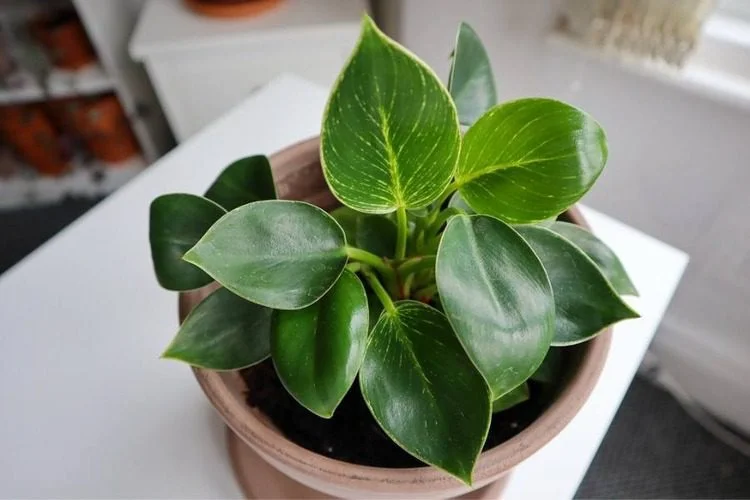
Propagate Philodendron 'Birkin' from a viable stem section that includes at least one node. A node is the point on the stem where leaves, buds or roots may emerge. Simply putting a detached leaf or petiole in water does not reliably produce a new independent plant. The Royal Horticultural Society (RHS) lists stem-tip and leaf-bud cuttings as propagation methods for 'Birkin'.
Birkin grows as a compact, upright, self-heading plant rather than a long trailing vine. Not every specimen has an accessible side stem for cutting. If a plant is still small or has only one healthy growing point, allowing it to mature is safer than cutting away its crown.
Before you start
- Choose a healthy established plant and a suitable active growth period, commonly spring through summer indoors.
- Find a stem section with a recognizable node and one or two healthy leaves.
- Clean sharp cutting tools, use a small clean pot or water container and choose suitable potting mix.
- Wear gloves and wash hands afterward. Philodendrons contain irritating calcium oxalates; keep cuttings away from children and pets.
- Check the plant's growth structure carefully: the leaf blade alone is not equivalent to a stem cutting.
Method 1: Root a stem cutting in water
- Identify a firm node just below healthy foliage, then make a clean cut below the node while retaining the cutting's viable stem tissue.
- Remove any lower leaves that would be submerged, but keep leaves higher up for photosynthesis.
- Place the node and cut end in clean room-temperature water, with leaves above the surface. Keep the container in bright indirect light.
- Replace cloudy water and keep the rooting area clean. Watch for soft black tissue, which can indicate decay.
- Once healthy roots have developed sufficiently to handle, pot in an airy medium with good drainage. Keep conditions steady as roots adapt from water to potting mix.
The RHS philodendron growing guide explains nodal cuttings and rooting them in water before potting.
Method 2: Root a cutting directly in potting mix
- Prepare a small container with drainage holes and a moist, airy houseplant propagation medium.
- Make a healthy stem-node cutting as above and place the node in contact with the medium while keeping leaves exposed.
- Put the pot in bright indirect light and maintain moderate warmth.
- Keep the medium lightly and evenly moist, not saturated. Excess water can cause stem rot before the cutting develops roots.
- Check gently for new root and leaf growth over time rather than tugging at the cutting daily.
This method avoids a later transition from water roots, but it can be harder to see root progress. Choose according to your growing conditions and ability to manage moisture.
Can you propagate Birkin by division?
Sometimes an established plant produces clearly separate offsets or rooted shoots that can be detached with their own roots. Do not arbitrarily split a single central crown or divide a plant lacking separate rooted portions. In contrast to rhizomatous orchids, Birkin is not generally propagated by cutting the main plant into any number of leaf sections.
What about air layering?
Air layering can be useful for some mature stemmed aroids, but a compact, short-stemmed Birkin often has too little accessible stem for it to be a practical beginner technique. Rooting a proper node-bearing cutting is more straightforward when the plant has sufficient stem length.
Aftercare for new and parent plants
- Light: bright filtered light; avoid sudden direct afternoon sun.
- Water: check the medium and avoid both sustained saturation and prolonged drought.
- Fertilizer: do not apply concentrated fertilizer to weak, freshly rooted cuttings; follow labels once new growth is established.
- Temperature: protect from cold drafts and sharp temperature changes.
- Variegation: striped patterns can vary with plant genetics and growth; not every cutting is guaranteed to look identical to the original.
Frequently asked questions
Will a Birkin leaf root in water?
A detached leaf may remain green for some time, but without a viable node and shoot tissue it is not a reliable way to grow a complete new plant.
How long does rooting take?
Time depends on the cutting, temperature, light and rooting medium. Roots can take several weeks to develop; avoid treating a fixed day count as a guarantee.
Is Philodendron Birkin safe around pets?
No. Philodendrons contain calcium oxalate crystals that irritate if chewed. Keep the parent and all cuttings away from animals and young children. The RHS notes Birkin is harmful if eaten.
Sources: RHS — Philodendron 'Birkin'; RHS — Philodendron Propagation and Care.