
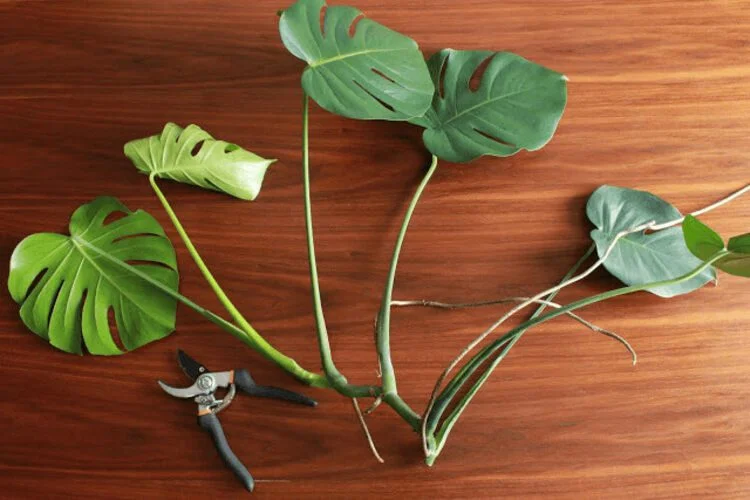
Quick answer: To propagate Monstera, take a healthy stem cutting that includes at least one node—the growth point where a leaf and often an aerial root meet the vine. Root the cutting in clean water or an airy, lightly moist medium. A leaf plus petiole without a piece of stem containing a node will not grow a complete new Monstera vine.
Find a real node before you cut
Trace the leaf stalk (petiole) back to the main vine. Look for its joint with the stem, often marked by a slight ring, swelling or aerial-root nub. The node, not the leaf blade, carries the growth point needed for a new shoot. Include a small section of stem on both sides of the node; do not cut through it.
If your Monstera is a single young plant with very short internodes, wait until you can confidently see the stem structure. A leaf-only cutting may remain green in a vase for some time, which is not proof it can produce a new vine.
Take a healthy stem cutting
- Choose a vigorous vine with no active pests, spreading leaf spots or stem decay.
- Clean sharp scissors or pruners. Wear gloves if plant sap irritates your skin.
- Cut below a node, leaving at least one healthy leaf and a viable growth point in the section you keep.
- Remove any leaf that would sit underwater or buried in propagation mix.
- Label the top and bottom if working with a leafless stem segment; keep the growing orientation correct.
For many common houseplants, university extension guidance favors stem pieces with more than one node. A single-node Monstera cutting can also work when that node is intact and healthy, but allowing more viable growth tissue can improve your margin for error.
Water propagation versus potting-medium propagation
| Method | What to do | Watch for |
|---|---|---|
| Water | Keep the node submerged, foliage above water, and change cloudy water promptly. Place in bright indirect light. | Slime, softened stem, lack of oxygen in stale water. |
| Perlite or airy mix | Insert the node into a moist, well-aerated propagation medium and leave the leaves above the surface. | Waterlogging, drying out completely, buried foliage. |
| Air layering | Wrap a node on the attached vine with barely moist sphagnum or another suitable medium, then cut below rooted tissue. | Saturated wrapping and cutting before usable roots form. |
Both water and medium can succeed; choose the method you can monitor consistently. Rooting hormone is optional, not a requirement.
Light, temperature and timing
Keep cuttings warm and out of direct midday sun. Bright indirect light supports root and new shoot growth; harsh sun can dehydrate rootless cuttings. An actively growing plant often propagates more readily in spring or summer, yet a healthy indoor Monstera may root at other times when conditions remain favorable.
Inspect cuttings every few days. Do not assume a fixed rooting date: growth depends on vine maturity, temperature, light and the cutting's condition.
When to transfer a water cutting to soil
Wait until there are usable roots rather than moving the piece immediately after the first tiny root tip appears. Iowa State Extension's general stem-tip propagation guidance suggests transplanting around an inch (2.5 cm) of root growth; larger Monstera cuttings may benefit from several branching roots that can support their foliage. Plant into a pot with drainage and a light mix, water to settle it, then let excess drain.
For the first weeks, avoid strong sun, fertilizer overload and constant saturation. Some temporary slowdown after transfer is normal while roots adjust to the new medium.
Common mistakes to avoid
- Leaf-only cuttings: A leaf without a stem node cannot grow a new climbing vine.
- Damaged growth points: Keep the node itself intact when cutting.
- Stagnant water: Refresh it and remove any soft decayed material.
- Soggy potting soil: New roots need air as well as moisture.
- Too-early pruning: Do not strip a small, weak parent plant of most of its leaves.
Frequently asked questions
Can I root a Monstera leaf without a node?
A detached leaf may stay alive temporarily but does not have the stem growth point needed to become a new vine.
Can I propagate an aerial root alone?
No. An aerial root is not a substitute for a viable stem node and shoot tissue.
Does a cutting need two leaves?
No fixed number works for every cutting. An intact node, viable growing tissue and low water stress matter more than leaf count.