
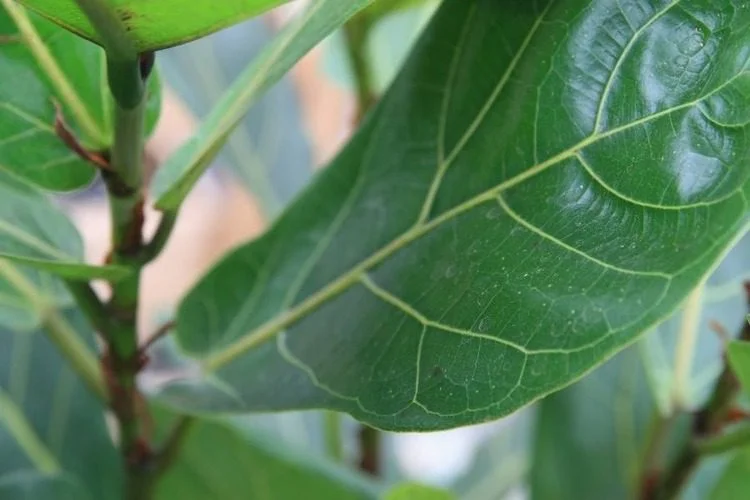
A leaning fiddle-leaf fig usually needs one of three things: more even light, better anchoring in its pot, or temporary support for a top-heavy stem. First find out whether the entire plant is tilting in the container or just its upper growth is bending toward a window.
Find the reason it leans
Leaning toward one window: new shoots often angle toward the strongest light. Whole root ball shifting: the plant may be loose, unstable or potted unevenly. A heavy crown on a thin trunk: the upper stem may need support while growth balances. Sudden collapse or a soft stem: investigate root or stem damage before staking.
Check the plant from two sides and gently test whether the soil/root ball moves separately from the pot. Do not rock or shake the trunk aggressively to test strength.
Fix uneven light without scorching foliage
Place the plant in a bright location with predominantly indirect light, ideally reaching more than one side of the canopy. Rotate the pot by a small amount periodically so all sides receive some exposure. A plant that has spent months leaning will not straighten instantly, but new growth can emerge with a better orientation.
Do not abruptly move a shaded fig into intense afternoon sun. If leaf color changes to pale or tan, follow the sunburn guide and adjust the location.
Stake a top-heavy tree correctly
- Choose a sturdy stake tall enough to support the unstable section.
- Insert it into the pot without spearing the main roots if possible.
- Use several broad, soft ties in loose figure-eight loops around the stem and stake.
- Leave room for the stem to grow; check ties monthly for rubbing or constriction.
- Reduce support only after the plant is stable and can hold its own weight.
A stake supports a structural problem; it does not fix rotten roots, poor light or an undersized container. Avoid tight wire, string or tape against the bark.
When repotting or pruning makes sense
If roots are tightly circling the container, pushing the plant upward or failing to anchor it, a slightly larger draining pot may help. Place the plant at its previous depth and tamp fresh houseplant mix gently around the root ball. A heavy decorative outer pot can improve stability while an inner nursery pot retains drainage.
For a very top-heavy canopy, careful pruning during active growth can reduce leverage and encourage a balanced shape. Do not remove most of the leaves at once from a stressed plant. See repotting guidance and branching and pruning advice.
Avoid these popular shortcuts
Repeatedly bending or wiggling the stem is not a reliable way to make a leaning houseplant upright. Extra fertilizer does not mechanically strengthen a loose root ball. If a plant is wilting, investigate moisture and roots before trying to train it with a stake.
Once the fig is in even light and properly supported, monitor new growth and gradually adjust support rather than forcing an old woody stem into a sudden new angle.