
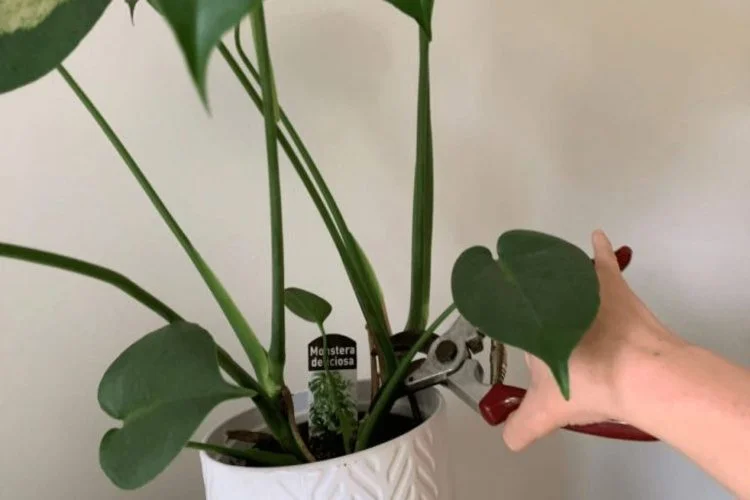
Quick answer: Prune Monstera with clean, sharp tools after deciding whether you want to remove a damaged leaf, shorten a long vine or make a propagation cutting. For a single leaf, cut its stalk close to the main vine without damaging the stem. For propagation, take a section of stem that includes a viable node. Healthy leaves need not be removed on a fixed schedule.
Choose the right cut for your goal
| Your goal | Where to cut | Expected result |
|---|---|---|
| Remove one dead or badly damaged leaf | Cut the petiole near its attachment to the stem, leaving the stem intact. | The leaf is gone; the same leaf does not regrow. |
| Shorten a long vine | Cut the vine at an appropriate internode while leaving viable nodes on the parent. | The plant may activate a growth point below the cut. |
| Root a new plant | Take a vine section containing at least one stem node. | New roots and shoots may form under suitable conditions. |
| Thin crowded growth | Selectively remove damaged or obstructive foliage. | Improved access and appearance without stripping the vine. |
Find the main stem, petiole and nodes
The petiole is the stalk that connects a leaf blade to the main stem. Nodes are joints along that main stem where leaf stalks and sometimes aerial roots emerge. Cutting a petiole removes a leaf; it does not create a propagation-ready stem cutting. For a new plant, preserve the node and growth point in the piece you take.
Examine large vines before making the first cut. Some Monstera stems are hidden behind old sheaths or climbing supports. Move the leaves aside gently rather than cutting where the structure is unclear.
Prepare tools and protect the plant
- Inspect the plant for pests, soft stems and root stress. Resolve severe active problems before major pruning.
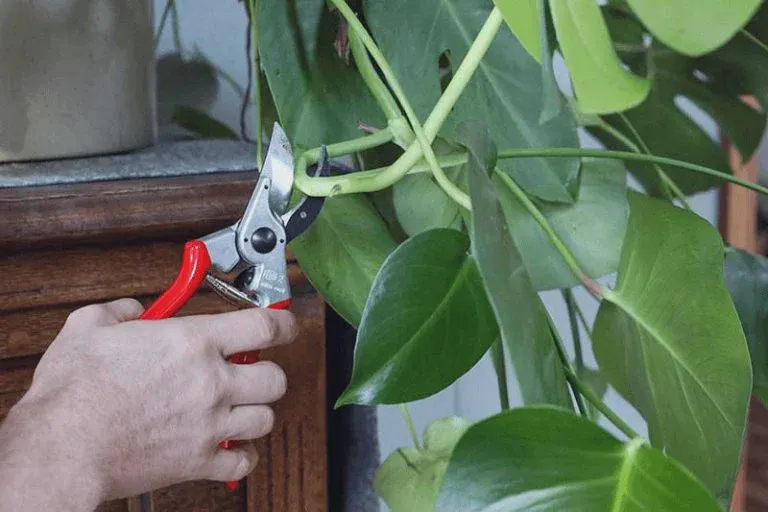
- Use sharp pruners that make a clean cut; clean the blades before use and between visibly diseased sections.
- Wear gloves and keep cut plant material away from children and pets. Monstera contains irritating calcium oxalate crystals.
- Choose a manageable amount of foliage to remove instead of cutting an already weak plant heavily.
- Support remaining stems on a stake, trellis or moss pole as needed.
Pruning damaged or yellowing leaves
Entirely dead leaves can be removed. A leaf with small brown patches still has useful green tissue and can often remain until new growth replaces it. Do not trim every blemish off a living leaf; the cause—water stress, strong sun, mechanical damage or pests—must be addressed separately.
If spots are spreading rapidly, inspect the plant and consider isolating it while checking for disease or pests. Remove suspect tissue with clean tools rather than spreading sap or debris across healthy leaves.
Pruning a leggy or overgrown Monstera
Long bare internodes can be a response to inadequate light or a plant growing without a good climbing support. Pruning changes the shape, but it does not solve low light. Move the plant into brighter indirect light and provide stable vertical support. On a large vine, plan how you will secure the remaining weight after removal.
Cutbacks are often easiest while the plant is actively growing because healthy new shoots can develop more readily. An indoor plant does not always have a strict winter dormancy.
Should you prune roots?
Do not routinely cut healthy roots as a shortcut to avoiding repotting. Root pruning can stress a tropical aroid. If a pot is crowded, examine the root ball and consider moving to a modestly larger container with drainage; remove only clearly decayed or damaged roots when needed. Avoid combining severe leaf and root pruning unless there is a compelling reason.
Aftercare and new growth
Water according to the remaining plant's root-zone moisture, not by a new rigid schedule. A plant with fewer leaves may use water more slowly. Avoid immediately increasing fertilizer to force fresh foliage. Observe the location of new shoots and guide them toward support.
If you saved node-bearing stem pieces, see the propagation guide for water and potting-medium rooting methods.
Frequently asked questions
Will a cut leaf grow back in the same spot?
No. A removed leaf blade does not regenerate. New leaves emerge from growth points on the vine.
Should I cut aerial roots?
Healthy aerial roots help climbing; redirect them into a support or medium when practical. Trim only when necessary to manage the plant, without confusing an aerial root with a propagation node.
Can pruning force larger leaves?
No. Leaf maturity depends more on plant age, light, support and overall growing conditions than on cutting back foliage.