
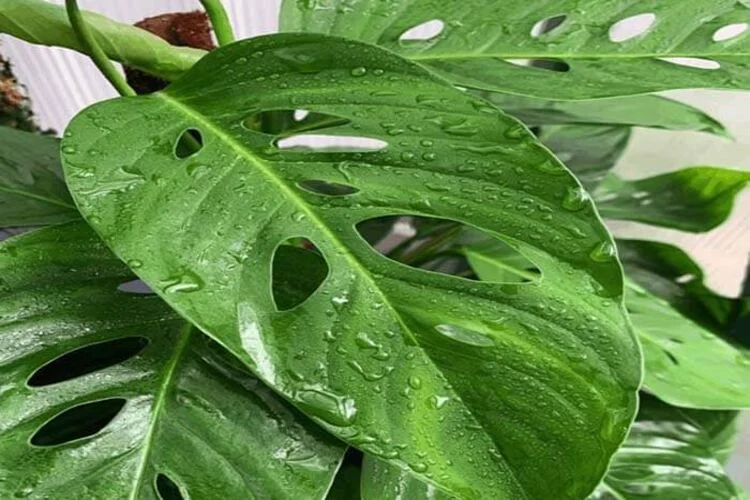
Quick answer: “Monstera Laniata” most often refers to Monstera adansonii subsp. laniata, an accepted infraspecific name listed by Royal Botanic Gardens, Kew. It is part of the M. adansonii group, not automatically a different unrelated species or a variegated cultivar. Care for it as a climbing tropical aroid: filtered light, warm conditions, a draining potting mix and a support for the stem.
What the botanical name means
Kew's Plants of the World Online lists M. adansonii as an accepted species with several accepted subspecies, including laniata. A subspecies is a botanical classification within a species; it does not imply that every retail plant labeled “Laniata” has a verified identification. The term is sometimes marketed loosely among “Swiss cheese” houseplants.
A label claiming “Laniata variegata” needs separate evidence of variegation in the actual plant. Laniata by itself does not mean yellow-variegated Monstera deliciosa Aurea, and the two should not be confused.
Leaves, holes and climbing habit
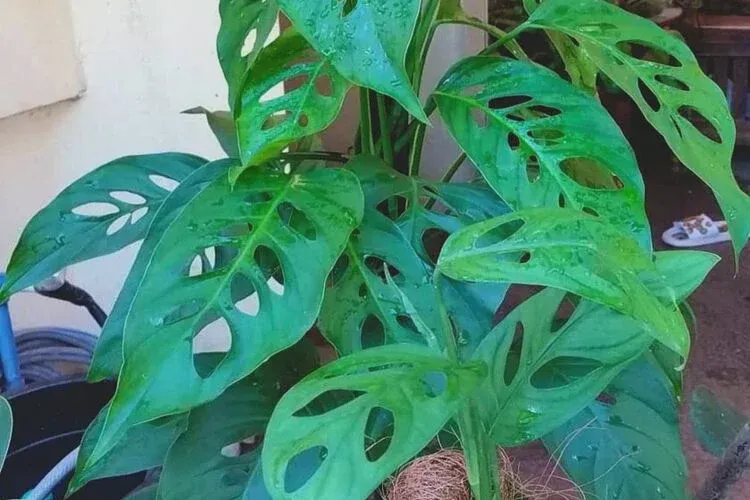
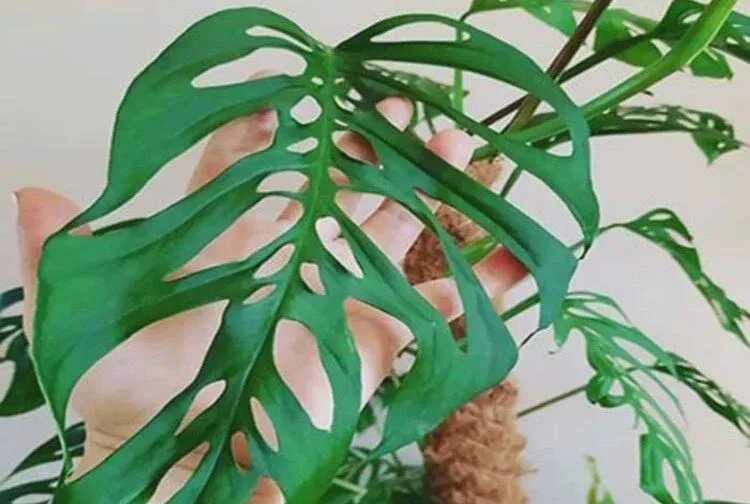
These vines develop naturally perforated leaf blades called fenestrations. Leaf size and the distribution of openings can vary with growth stage, available light and the particular plant. A small juvenile leaf is not proof that the specimen is a different species.
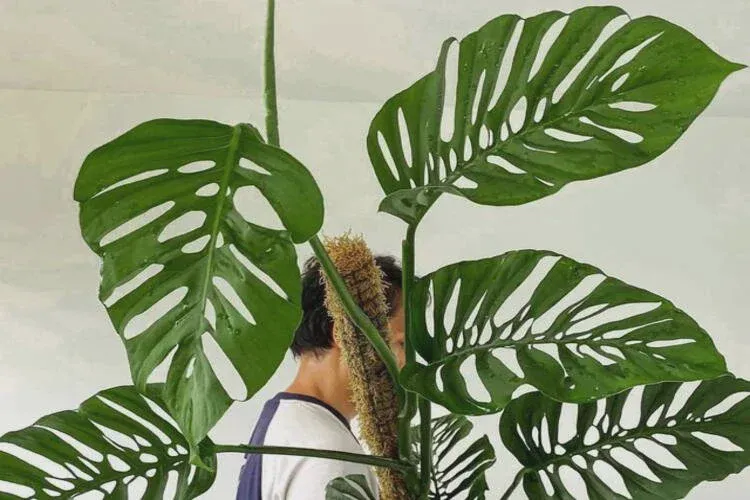
Like other climbing Monsteras, the stem can produce aerial roots that attach to a support. A sturdy pole or trellis can help keep its foliage visible and manage long stems indoors.
How much light does Monstera Laniata need?
Provide bright indirect light and avoid prolonged harsh midday sun on foliage that has been grown in shade. Too little usable light can lead to smaller leaves and elongated stems. If you move the plant closer to a window or introduce grow lights, acclimate it gradually while checking for bleaching or scorching.
There is no species-specific hourly daylight quota established by its trade name. Evaluate the vine's steady new growth instead.
Watering: check roots and the pot, not a fixed weekday
Keep the mix evenly managed but not constantly saturated. Before watering, check a little below the top of the substrate and consider the pot's weight. When the plant needs water, wet the root ball thoroughly and let the excess drain. Remove water left in an outer cachepot.
Use a pot with drainage and a loose houseplant medium, such as an appropriately balanced mix containing coir or peat and aerating components. Avoid compacted garden soil in indoor containers. An oversized pot of wet mix can prolong root stress.
Humidity, warmth and airflow
As a tropical vine, this Monstera appreciates stable indoor warmth and avoids cold drafts. Normal moderate household humidity is often workable; persistently dry air may increase leaf-edge crisping. Use a hygrometer rather than assuming every brown margin means low humidity. A clean humidifier can help in an overly dry room, while repeated misting is short-lived and may promote disease if leaves stay wet.
Support, fertilizer and repotting
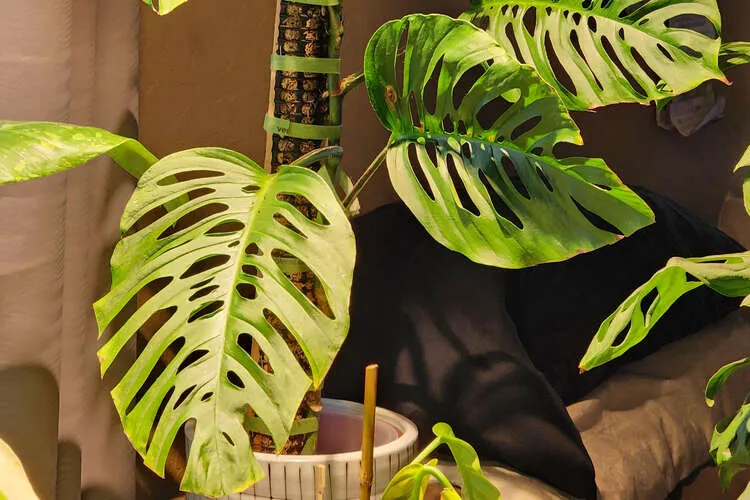
Secure the main stem loosely to a sturdy support, leaving petioles free. Feed lightly during active growth with a balanced houseplant fertilizer if the plant needs added nutrients, following label instructions. More fertilizer cannot correct darkness or root rot.
Repot when the root ball is genuinely crowded or the substrate has degraded, using only a modestly larger draining pot. Do not automatically repot every year or cut healthy roots without reason.
How to propagate a Laniata cutting
- Inspect the stem for a viable node where a leaf meets the vine.
- Take a clean stem cutting including that node; a leaf alone is not a complete propagation cutting.
- Place the node in clean water or a lightly moist airy medium, keeping foliage out of water.
- Provide bright indirect light and warmth; refresh cloudy water promptly.
- When several usable roots develop, transfer into a suitable draining mix and monitor without overfeeding.
Rooting times vary with conditions, so avoid fixed deadlines. Cut only from a vigorous, pest-free parent vine.
Troubleshooting Monstera Laniata
| Symptom | Check first |
|---|---|
| Yellowing lower leaves | Waterlogging, old leaves, root damage and light |
| Brown crispy edges | Dry mix, fertilizer salts, sun, drafts and humidity |
| Soft roots, persistent wilting | Drainage and root-zone oxygen |
| Silvery scarring and distorted new growth | Thrips or other pests under leaves |
| Smaller new leaves | Light, climbing support, plant health and maturity |
Leaf appearance alone seldom establishes a single cause. Check the environment and root zone before choosing a remedy.
Safety and buying advice
NC State Extension describes Monstera adansonii as toxic when ingested and capable of causing mouth and skin irritation. Keep it away from pets and curious children, and use gloves when sap sensitivity is a concern.
If a vendor asks a premium for “subspecies laniata,” request actual plant photos and its nursery identification. A trade label is not botanical verification.
Frequently asked questions
Is Monstera Laniata the same as adansonii?
Under Kew's accepted taxonomy, laniata is a subspecies within M. adansonii. Retail usage can be less precise.
Does Laniata automatically mean variegated?
No. Variegation is a separate foliage trait; check the actual plant.
Can I propagate a leaf without a node?
No. A stem node with a viable growth point is needed to grow a new climbing vine.